
 English (United Kingdom)
  Italiano (Italia)
Want to enjoy your 5.1 Home Theater system without drilling walls or hiding cables in channels? This guide shows you smart, non-invasive ways to mount your satellite speakers — using wall brackets, adhesive solutions, and clever tricks to keep your setup tidy and your walls intact. Ideal if you rent or just hate making a mess!
Introduction
I recently purchased a 5.1 Home Theater DVD player equipped with six speakers (five satellites and a subwoofer) to set up in the living room, aiming to enjoy movies with that characteristic "Cinema Effect."
In the living room, there's a piece of furniture that comfortably houses both the DVD unit and the subwoofer, along with the three small front satellite speakers. The issue arises when it comes to mounting the two side satellite speakers, which need to be positioned on either side of the listener. These often end up far from the DVD player, and unless you opt for an "In-Wall Installation," you're left with unsightly exposed wires.
I've found an economical and visually pleasing solution: using polystyrene mouldings, the kind typically used to decorate ceiling corners. You can purchase these for a few euros at hardware stores in lengths of 2 or 3 metres, available in various widths and shapes. I chose a relatively small one that, once installed, leaves a hollow gap between the moulding and the corner of the wall. I then placed the wire along the wall as close to the ceiling as possible, securing it with small nails.
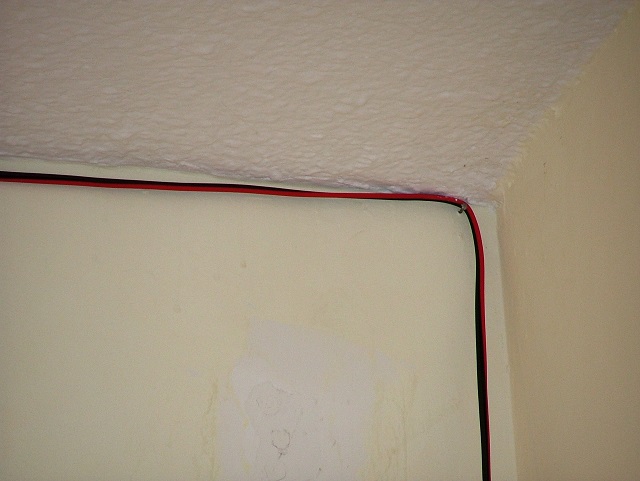
At this point, I started applying transparent silicone to the plastic moulding to stick it in place. If you ask at hardware stores, they surely have adhesives specifically designed for this purpose, but I happened to have silicone at home, and it worked perfectly fine.
A tip: wash your hands frequently because polystyrene mouldings tend to get dirty very easily, and once stained, it's quite difficult to clean them back to their original state.
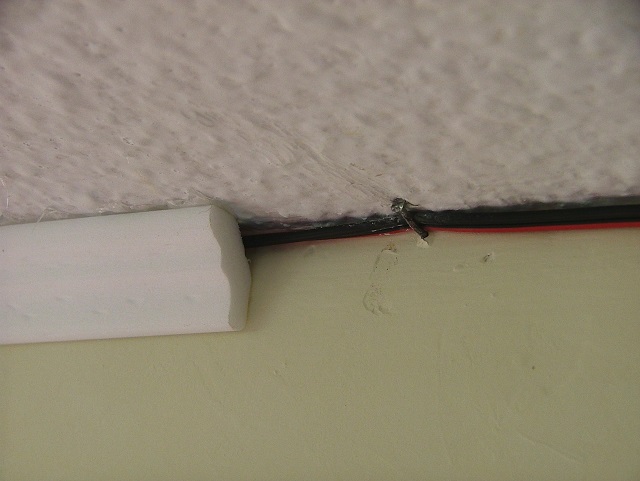
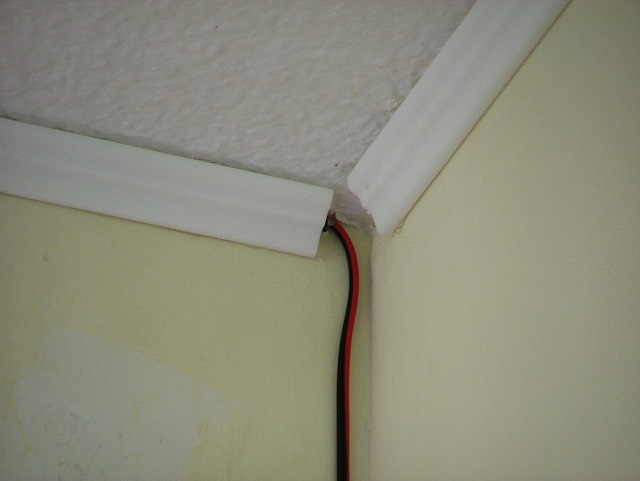
Clearly, the moulding needs to be installed along the entire perimeter of the ceiling, even in areas that won't be hiding any wires; otherwise, the final effect will be less impactful. In the corners where the small side speakers will be placed, a small gap should be left to allow the wire to come through.
.
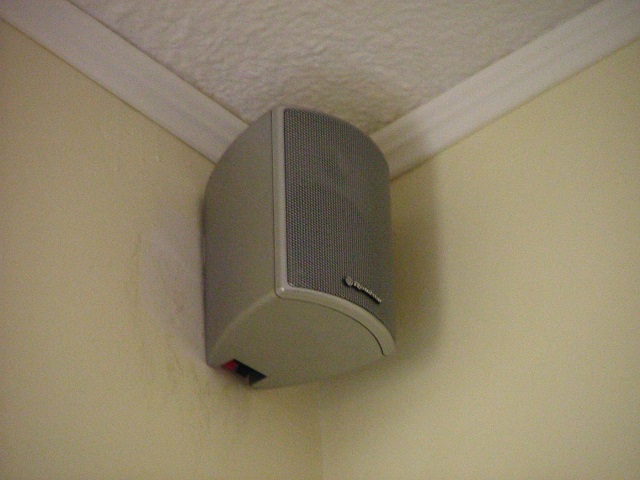
Don't worry if the wire protruding from the moulding doesn't look aesthetically pleasing, as it will all be hidden by the speaker itself.
I hope you found this article interesting.
Thank you all!
Luciano (Capitan Farloc)