
 English (United Kingdom)
  Italiano (Italia)
Indice
Still using an old ceiling light with a circular fluorescent tube? In this DIY guide, we’ll show you how to upgrade it by replacing the tube with two LED bulbs. It’s an easy, cost-effective way to modernise your lighting, reduce energy consumption, and keep your existing light fixture. Step-by-step instructions included!
Introduction
I have a ceiling light in the bathroom that has been there for several years.
When I installed it, energy-saving bulbs were not yet widespread, and the viable alternative to incandescent bulbs for reducing electricity consumption was fluorescent tubes.
This particular fixture uses a 22W circular fluorescent lamp, known as a T9 or “circolina.”
Why I Decided to Make the Replacement
The downsides of fluorescent lamps include their delayed start time, often accompanied by a series of flickers before stabilising. Additionally, as the ballast ages, it can start to produce a rather bothersome buzzing sound.

What to Replace the Circolina With?
For these reasons, I decided—as I had already done in the other bathroom where there was a 60 cm linear fluorescent lamp—to replace it with an LED lamp.
In that case, I found an LED lamp at a reasonable price (€6), which could be installed as a direct replacement for the fluorescent lamp without requiring modifications to the wiring (not even removing the ballast), by simply taking out the starter.
For this reason, I looked for something similar for my circular lamp and, naturally, I found it. However, the price wasn’t as advantageous.
I have to say that with more thorough research, you can find something cheaper, but still, in my opinion, the cost remains a bit too high.

Is It Worth Replacing Fluorescent Lamps with LED Bulbs?
At this point, inspired by an idea shared by Mariobrossh on a forum, I started thinking about how to modify the ceiling light to accommodate one or more screw-in LED bulbs. These are now available in good quality at significantly advantageous prices. However, before proceeding, I needed to ensure that the luminous intensity would be at least equivalent to that provided by the lamp currently installed in the ceiling light.
I verified that the installed lamp consumed 22 Watts and delivered a luminous flux of 1,350 Lumens.

At this point, inspired by an idea shared by Mariobrossh on a forum, I started thinking about how to modify the ceiling light to accommodate one or more screw-in LED bulbs. These are now available in good quality at significantly advantageous prices. However, before proceeding, I needed to ensure that the luminous intensity would be at least equivalent to that provided by the lamp currently installed in the ceiling light.
I verified that the installed lamp consumed 22 Watts and delivered a luminous flux of 1,350 Lumens.

How to Make the Replacement
I climbed up the ladder, removed the ceiling light from the ceiling, and brought it to the workbench to assess the modifications needed.
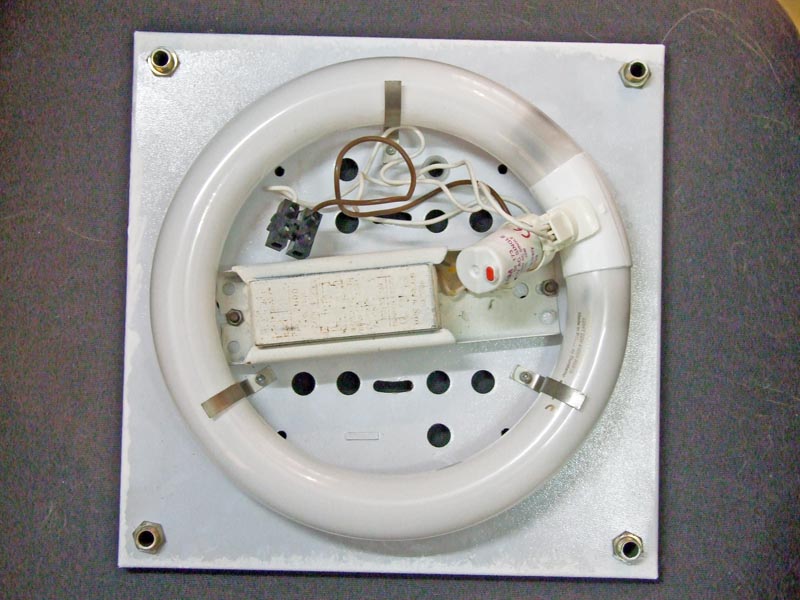
Dismantling the Old Components
First, I removed all the components attached to the chassis, leaving it completely empty.
While most of the components were mounted with screws, the lamp holders were secured with rivets. I had to drill them out using a 5mm drill bit with a power drill.

Assembling the New Components
I picked up two ceramic E27 bulb holders (the large screw-in type) for €1.50 each.
In reality, energy-saving bulbs have relatively low heat dissipation, so plastic bulb holders could have been used just as easily. However, I came across these ceramic ones.
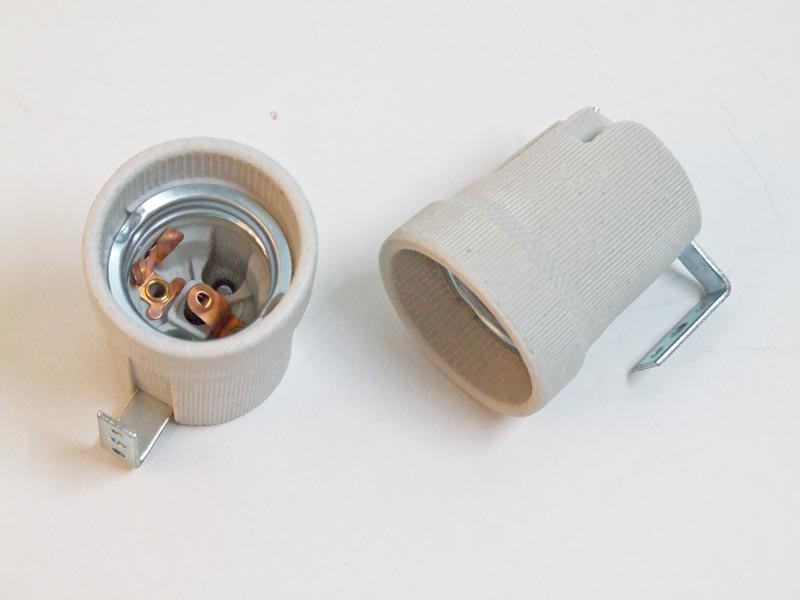
The chassis had plenty of pre-existing holes, so I didn’t need to drill any additional ones and was able to use the ones already present.
The bulb holder brackets had pre-threaded holes for M4 screws. I secured them with screws and then added a locknut. Once tightened, this allowed me to adjust the position of the bulb holder by rotating it to the most suitable angle, without the fastening screw coming undone.

Wiring the Connections
To make the electrical connections, I used a "mammut" terminal block, which I secured to the chassis with a bolt.
I then connected the bulb holders using electrical wires I already had at home. To keep everything tidier, I used pieces of heat-shrink tubing to run the wires through.
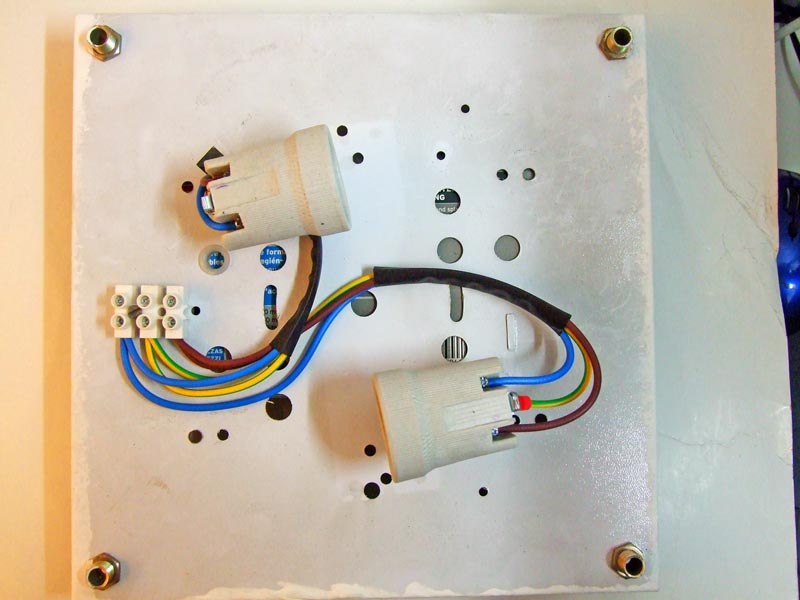
Preliminary Testing
Before reassembling everything, it's essential to conduct a test.
I took a cord with a plug, which I always keep for this type of trial (salvaged from an appliance before it was taken to the recycling centre), and connected it to the terminal block.
I then installed the bulbs, adjusted the bulb holders to what seemed like the correct position, and slightly bent the bulb holder brackets to prevent the bulbs from coming into contact with the chassis.

While keeping a safe distance, I plugged it in—and the bulbs lit up perfectly.
Preliminary testing completed successfully!

Reassembly and Final Impressions
All that was left was to reinstall the ceiling light in its place and make the electrical connections to the power wires.
I must say that the brightness has indeed improved, but the best part is finally having a bulb that lights up instantly. Unlike the previous fluorescent lamp, which, especially as it aged, took a rather long time before it could fully turn on.

I thank everyone who took the time to read and found this article useful or interesting.
Until next time!
Luciano (Capitan Farloc)