
 English (United Kingdom)
  Italiano (Italia)
Indice
Want to give your Christmas tree a rustic and handmade look? In this guide, we’ll show you how to make original string ball ornaments using just twine, glue, and balloons! It’s an easy and fun DIY project that brings a warm, crafty touch to your holiday decorations. Great to make on a cozy winter afternoon—especially with kids!
Introduction
This year, I wanted to come up with an original idea to add some DIY decorations to the Christmas tree. I was quite undecided about what to make, but then a colleague told me about a teacher who had created some unusual "Christmas tree baubles" using twine… I saw something similar in a shop, and the DIY spirit within me was unleashed—I couldn’t hold it back anymore.
Twine Christmas Tree Baubles
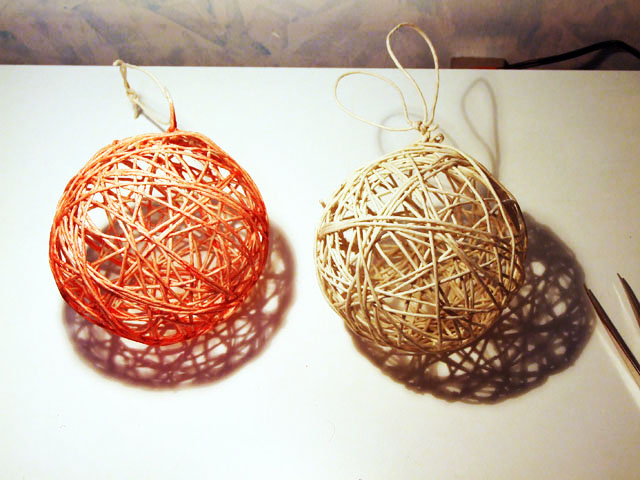
Here’s the result—what do you think?
If you like them, I’ll explain how they can be made with minimal cost and just an hour of your time. It’s a fantastic activity to enjoy with your children, who will have a blast creating such a unique decoration.
What You’ll Need
The materials, as I mentioned earlier, can be gathered for just a few euros, partly from a hardware store and partly from a stationery or toy shop. Here’s what you’ll need:
- A spool of soft, thin, white twine—the kind used in kitchens to tie meat.
- A jar (even a small one) of vinyl glue.
- A bag of small decorative balloons.
- Acrylic paints, tempera, or watercolours—any water-soluble paints will do.
- A medium-sized paintbrush.
- Scissors, tweezers, pliers, etc.—the usual tools that should always be handy when starting a project.

The Balloon
First, inflate one of the balloons to the desired size for your Christmas tree bauble and tie a knot at the opening to keep it from deflating.
Then, take about ten metres of twine from the spool and tie one end around the "neck" of the balloon, just below the knot you made.
Leave a long enough piece of twine extending from the knot—this will later serve as the loop for hanging the bauble on the Christmas tree.

The Twine
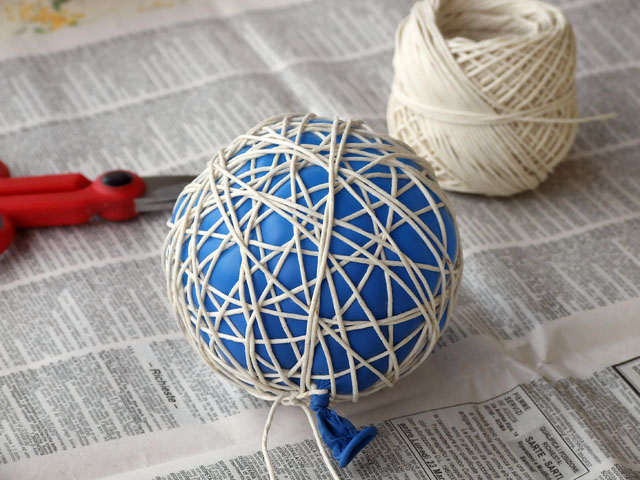
At this point, we begin wrapping the string around the balloon, trying to keep it tight enough without squeezing it to the point of deforming the balloon. The string should be wrapped while continuously turning the balloon so as to distribute it as evenly as possible, avoiding spots where the string overlaps too much or areas with large empty spaces. The secret? With each loop, aim to cover the largest empty spaces.
PVA Glue
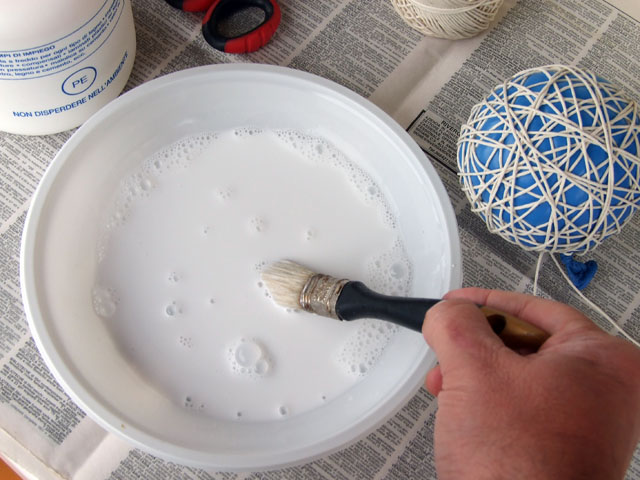
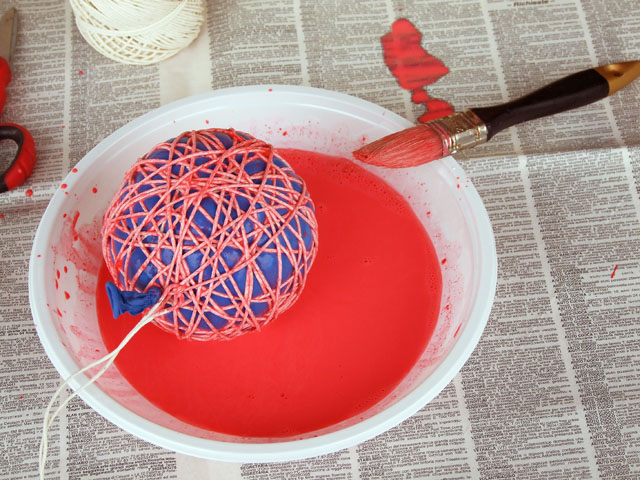
Having done this, we will take a disposable plastic plate and mix one part PVA glue with two parts water to create a very fluid adhesive.
Acrylic Paints
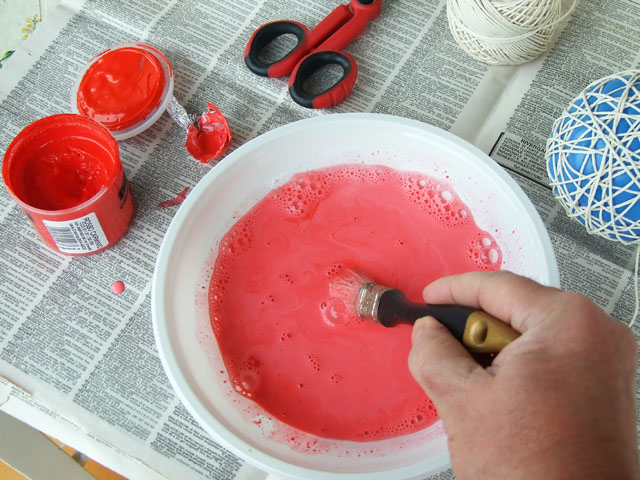
If needed, we can mix some paint with the glue; I used acrylic paint, but tempera or watercolour should work just as well. An alternative to colouring the glue is to dye the string before wrapping it around the balloon. In this case, we will dilute the paint in water, soak the string in it for about ten minutes, and then lay it out to dry.
The Brush
Once we place our balloon on the plate (otherwise we'll end up covering our workspace with glue), we use the brush to apply the glue evenly over the string, going over it several times.

We’ll need to focus on the areas where the glue struggles to reach. If it ends up forming films that close off the spaces left between the string, it means the glue is too thick, and we’ll need to add more water.
Drying
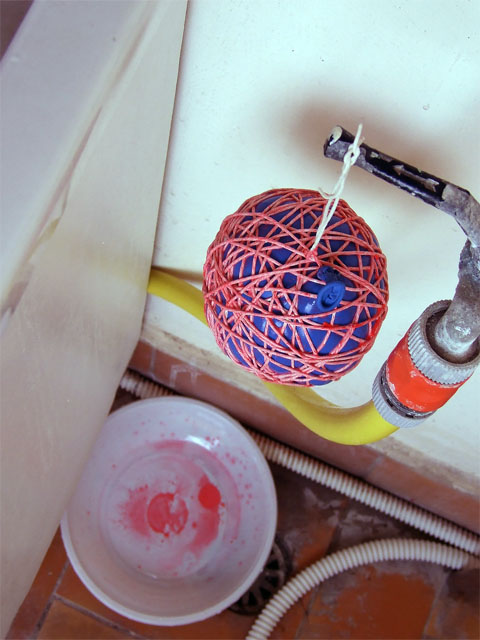
Once this is done, we should hang our "ball" in a dry place to let it dry.
The drying time depends on many factors. Naturally, if you can place it near a radiator, the heat and drier air will speed up the process... otherwise, a few hours at room temperature should be sufficient.
Oh, and it's definitely a good idea to place a container underneath the hanging ball to catch any excess glue that might drip down.
The Scissors
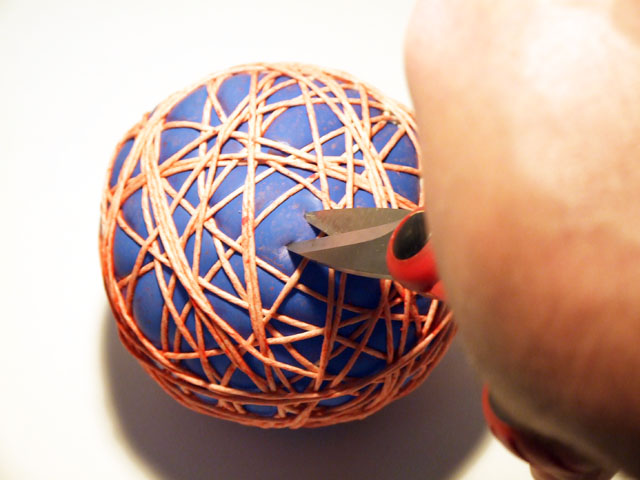
Once everything is completely dry, the string will have become rigid due to the PVA glue, which essentially "plasticized" it. However, since the glue has turned transparent (one of the key characteristics of PVA glue), the string will appear as if it has simply been coloured.
Using a pair of scissors or a sharp object, we pop the balloon. You'll notice that the PVA glue doesn't adhere to the plastic of the balloon, which will detach quite easily.
The Tweezers
Next, the mouth of the balloon should be cut (remember, we had tied the end of the string there, which now won’t come undone due to the glue) right near the knot. Then, using a pair of tweezers, we grasp the remnants of the balloon through one of the gaps in the string to pull it out.

Conclusions
This is the final effect of the decorations, ready for use.
Naturally, creativity can run wild here—you could hang some objects inside, add fairy lights for the Christmas tree, or include anything else that comes to mind.
The second decoration, as shown in the photo, was coated only with PVA glue diluted with water, without adding paint, to preserve the natural colour of the string.
I hope you enjoyed this article and that it sparked a thousand new and original ideas to hang on your Christmas tree.
In the meantime, I thank you and bid you farewell.
Luciano (Capitan Farloc)