
 English (United Kingdom)
  Italiano (Italia)
Indice
Need a bookcase or shelving unit and want something simple, custom-sized, and handmade? In this guide, we show you how to build a basic wooden bookcase — perfect for books, decorations, or anything you want to keep tidy. With just a few planks, some basic tools and a bit of DIY spirit, you can create a sturdy and practical piece of furniture that adds a personal touch to any room in your home.
Introduction
I had a little corner at the end of the hallway near the shoe cabinet that had been teasing me for quite a while… I wanted to build something there, but the space was rather limited, and I couldn’t quite figure out what to put there. Then one day, while trying to organise the mountain of music CDs, computer discs, DVDs, and some old videotapes, I had an epiphany… A CD/DVD/Videotape storage bookshelf!
The Project
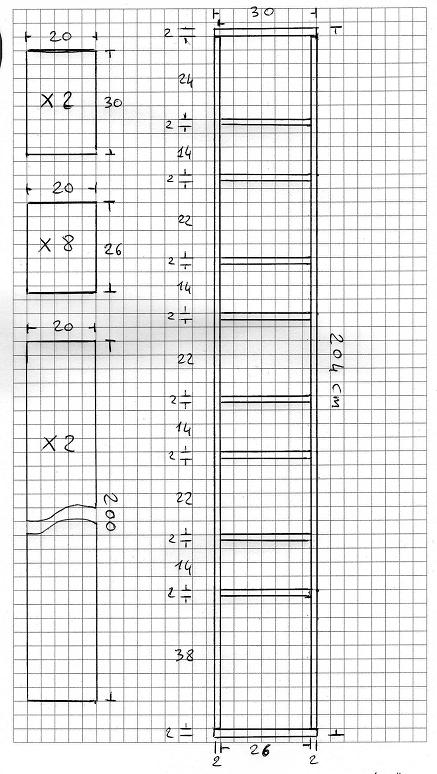
I grabbed a measuring tape, paper, and pencil and started measuring the available space, as well as the dimensions of the CD, VHS, and DVD cases, then began sketching some ideas. It's crucial to have a clear plan when working with wood—if you start cutting without a detailed blueprint, you risk making mistakes and ending up with pieces that can't be assembled properly. The design I created features 9 compartments: 4 for CDs, 4 for DVDs and VHS tapes, and one larger one for storing vinyl records. You can download the blueprint in A4 format via this link:
Construction Blueprint for the CD/DVD Shelf in A4 Format.
Oh, and one last thing! The blueprint includes the measurements of my hallway space, but you can absolutely adjust the shelves—widen, move, raise, or lower them—to fit your own needs. Just take my advice: make a sketch with all the measurements first, or it'll be easy to make mistakes.
Materials Used
The choice of materials is quite diverse—it depends on the quality you're aiming for and, naturally, your budget. A good effect can be achieved using veneered plywood (meaning plywood with exposed surfaces already laminated with a more "noble" wood) and finishing the edges with veneer strips of the same wood. These adhesive strips are applied using heat—typically with an iron. However, using these materials tends to increase costs. The shop I consulted quoted a price ranging between €60 and €100, but this also depends on the type of plywood, the veneer quality, and the shop itself. I would avoid using particle board, as it's harder to work with, heavier, and less durable. The project also involves using wooden dowels to avoid visible screws, and particle board tends to crumble when drilled near the edges. In 2008, I chose to buy two raw spruce planks typically used for carpentry, with a thickness of 25mm, a width of approximately 20cm, and a length of roughly 4m (cut to a height of 2m so they could fit in my car), for a total cost of about €15–€20.

Planing the Wood
These planks are sold as they come from the sawmill—rough and unpolished. The dimensions (apart from the fixed thickness) may vary from plank to plank, so you'll need to find a patient seller who lets you pick planks of very similar width, without major defects (knots or cracks), and most importantly, "straight" ones. This approach keeps the cost very low (though the wood quality is limited as well—you won't be finding mahogany planks here, of course!). With a few extra coins, you might find pre-planed planks, or alternatively, you can use the money saved to buy a good electric planer and do the planing yourself. However, I must warn you: if you choose the second option, the planer has a working width that is considerably narrower than the width of the plank. This means you'll need to make 3 or 4 passes, resulting in inevitable uneven spots that you'll have to smooth out manually with sandpaper and "elbow grease." Not to mention the wood shavings—you'll end up with bags full of shavings and sawdust. In my case, I reduced the thickness from 25mm to 20mm and filled two bags with shavings and dust.

Protective Wood Treatment - Paint or Wax?
Once all the pieces have been cut to the specified measurements, the wood will need to be treated. Treating the wood is essential to protect it; otherwise, it would be too porous, easily absorbing moisture, dust, and dirt. There are various treatment methods available. Personally, I'm not very experienced with paints, so I couldn't guide you on the types of primers and paints to use, but visiting a paint shop will provide you with all the necessary advice (and the paint itself, of course). Instead, I opted for a simpler, more natural treatment (though unfortunately more labour-intensive): beeswax. You can find it both natural and coloured, and using a lightly coloured one can enhance the wood's grain effect beautifully. Beeswax should be spread onto the wood with a cloth, then left to be absorbed. Afterward, with another clean, soft cloth (and plenty of elbow grease), you polish the wood to finish the treatment.

Preparing the Joints - Dowelling
As mentioned earlier, one of the methods for assembling wooden parts without visible screws is the so-called "dowelling" technique, which involves using small "dowels"—essentially wooden cylinders (usually beech)—to support the wooden pieces you want to join. To use dowelling, you need to drill both pieces to be joined so that the holes are perfectly straight and aligned; otherwise, the pieces won't fit together properly. There are two systems for aligning the holes: "Markers" and the "Dowel Jig." The first system consists of metal cylinders matching the diameter of the dowels you want to use, with one pointed end. Once the dowel holes are drilled in one piece, you press it against the other piece, and the markers leave an imprint to guide the corresponding holes. However, using markers has the drawback of requiring careful attention to drill perpendicular holes. Unless you use an accessory to guide the drill, it's easy to go off course, making assembly impossible. Dowelling is instead done using a dedicated "dowel jig," equipped with metal bushings that ensure the drill bit stays straight. The stopper you see on the drill bit (in the photo) is used to make the hole slightly deeper than half the total length of the dowel. An excellent online guide explaining how to perform dowelling and use a dowel jig is the one written by Wolfcraft for their jig. It's available as a PDF, and I recommend downloading it. You can find it here.
Guide to Wood Joints (Wolfcraft)

Two Dowels per Shelf Should Suffice
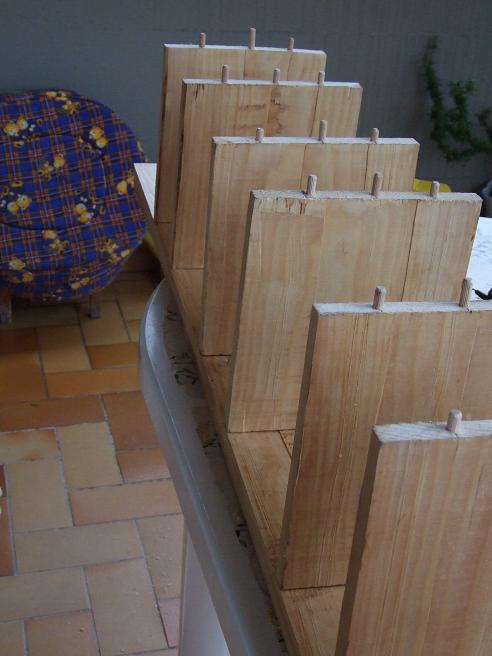
Two dowels per shelf would have been more than sufficient (as the weight of a few CDs over 30cm width is minimal), but once you get the hang of using this tool, it’s not particularly complicated. You'll just need a few woodworking clamps (to hold the pieces steady during drilling) and a good wood drill bit—these will ensure more precise drilling. Each piece must be used as a guide to mark the points for drilling holes where it will be positioned. You'll need to mark both sides to identify where and how each piece should be assembled. A simple tip: when using woodworking clamps, make sure to use a few pieces of plywood where the clamp “bites” the wood. This will prevent the wood (which is quite soft) from being crushed, leaving unsightly marks. After all this, you can proceed with assembly. First, attach all the shelves to one side of the bookcase, then mount the other side on top. Finally, you can add the top and bottom pieces, which will also serve to hold everything together.
Assembling the Pieces
There are two options for securing everything together. The first involves using glue to assemble the shelves, which keeps everything firmly in place. However, you'll need very large woodworking clamps to hold the parts together until the glue dries. The second option uses screws in hidden areas. Specifically, I used "L-brackets," which are positioned on the back of the shelf to remain out of sight.
It's worth noting that, in my design, the top and bottom pieces of the shelf are 4cm wider than the other shelves to cover the full width of the bookshelf and allow the side panels to rest on them. This choice was made because of where the shelf was installed (as you can see in the photo in the following section). The side panels were hidden, so it wasn't an issue. However, if the side panels are visible, it’s better to make these pieces the same length as the shelves.
Another thing I want to point out is the limited patience of the lumber seller I dealt with (my fault—I went just before closing time). Because of this, I couldn’t insist too much, and the planks I bought had slightly different widths. I resolved the problem by using the narrower plank for the shelves and aligning them at the front of the cabinet, so the shorter side ended up at the back, forming a step visible in the photo. Since it’s hidden, it doesn’t affect the quality of the finished piece.

The Final Result
In this last photo, you can see the completed CD shelf in action. You could attach a sheet of plywood or another material cut to size to the back of the shelf. This would cover the wall behind it and also make the structure more solid, preventing it from being prone to lateral stress. However, this isn't the case here because (aside from the improved aesthetic value) the very narrow shelves and the fact that the bookcase was positioned snugly between the wall and another piece of furniture mean there's no possibility of any lateral movement.

Naturally, if you need a bookcase or shelf of different dimensions, all you need is a pencil, paper (and a measuring tape) to sketch out what you require and then... start over again!
Thank you to everyone who read this little guide with interest, and... until next time!
Luciano (Capitan Farloc)