
 English (United Kingdom)
  Italiano (Italia)
Indice
- Washing Machine Inlet Valve: Everything You Need to Know Before You Start
- What Is the Washing Machine Inlet Valve and Where Is It Located?
- What Does the Inlet Valve Look Like? Shape and Main Components
- How Does the Washing Machine Always Fill with the Right Amount of Water?
- The Water Intake Circuit: A Look Inside
- How the Inlet Valve Works: The Internal Diaphragm Mechanism
- The Inlet Valve Opening: How the Solenoid Acts on the Diaphragm
- Washing Machine Not Filling with Water or Filling Too Slowly? Faults, Symptoms and Solutions
- Frequently Asked Questions About the Washing Machine Inlet Valve (FAQ)
- Conclusions and Acknowledgements
Washing Machine Inlet Valve: Everything You Need to Know Before You Start
The machine starts up, you can hear the programme running, but no water comes in — or it trickles in so slowly that the machine throws an error before it's even had a chance to start washing. Sound familiar? Nine times out of ten the culprit is a small and often overlooked component: the inlet valve (also known as the water inlet valve or solenoid valve), the electrically controlled tap that manages the flow of water into the washing machine.
In this guide we'll look at what it is and how it's built, how the internal mechanism works, how to recognise the most common faults and how to check whether it really is the source of the problem — everything you need to diagnose the fault and, in most cases, fix it yourself without calling out a repair technician.
What Is the Washing Machine Inlet Valve and Where Is It Located?
The name says it all: inlet valve = a valve (in other words, a tap) controlled electrically. It's the component that, on instruction from the control unit, opens and closes the flow of water from the mains supply into the washing machine.
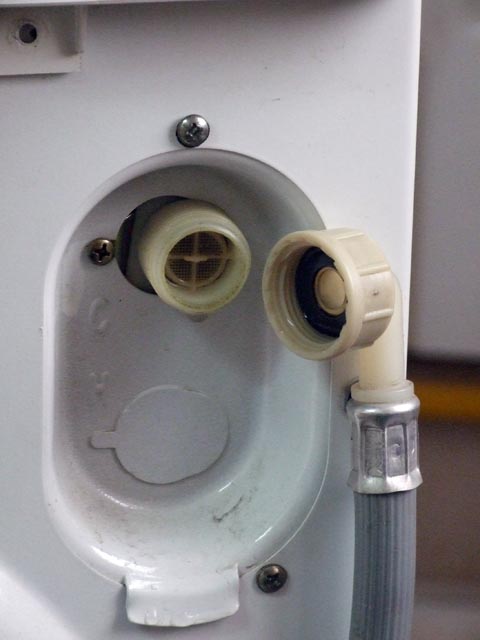
It's located at the back of the machine, right where the water supply hose connects — and that's no coincidence: on most models, the threaded fitting where the hose screws in is already an integral part of the valve body itself, as you can clearly see in the photo.
What Does the Inlet Valve Look Like? Shape and Main Components
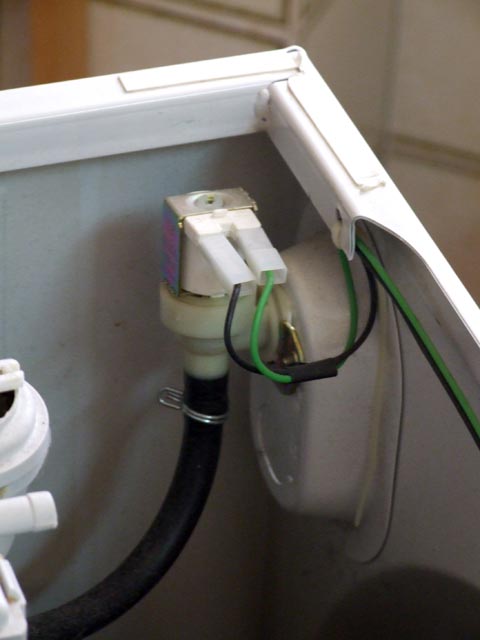
Viewed from inside the washing machine, the inlet valve has an approximately cylindrical shape. At the front end there's a cone-shaped outlet from which the connector tube runs — the tube that carries the water through to the detergent drawer. On the opposite side, facing the outside of the machine, is the threaded fitting where the supply hose screws in, as seen in the previous photo.
Mounted on the top of the body is the solenoid — the electromagnetic coil that acts as the real "engine" of the whole mechanism — from which the two electrical connectors protrude, ready to receive the opening signal from the control unit.
How Does the Washing Machine Always Fill with the Right Amount of Water?
The water isn't filled at random: for every phase of the cycle — washing or rinsing — there's an optimal level set at the factory that the machine needs to reach with precision.
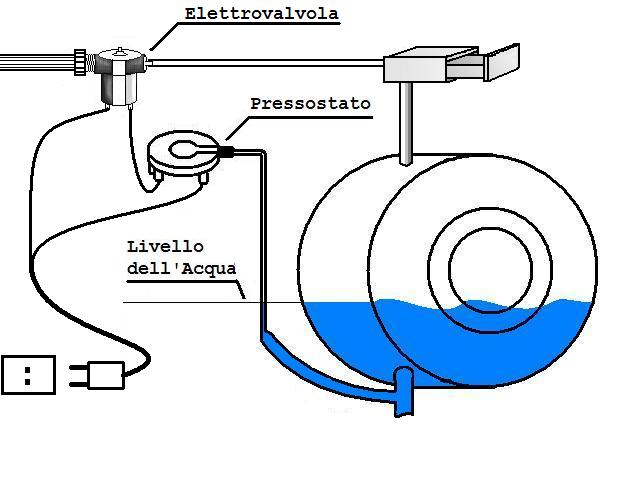
The mechanism is simple and elegant: the control unit opens the inlet valve to let the water in, while the pressure switch constantly monitors the water level in the drum. As soon as the water reaches the desired level, the pressure switch sends a signal to the control unit, which closes the inlet valve and stops the flow.
The diagram alongside illustrates this principle in a simplified way: in reality the electrical connections are more complex and everything is coordinated by the control unit, but the basic concept is exactly this.
💡 Note: if you'd like to learn more about how the pressure switch works and how to test it if something goes wrong, you can read the dedicated article: The Washing Machine Pressure Switch: How It Works
The Water Intake Circuit: A Look Inside
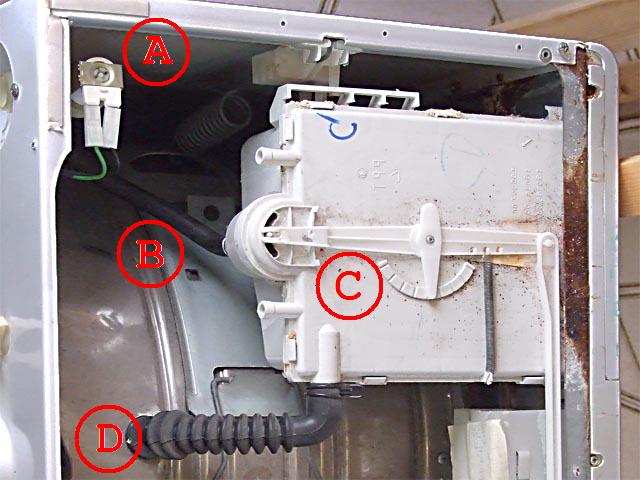
By removing the top panel of the washing machine you can see all the components of the water intake circuit described so far. In the photo they are labelled with letters:
- (A) The inlet valve — top left, with the electrical command wires clearly visible
- (B) The connector tube — runs from the inlet valve and carries the water through to the detergent drawer
- (C) The detergent drawer — the water flows through it, dissolving the detergent before dropping down into the drum via a rubber tube at the bottom, not visible in this photo
- (D) The air vent hose — connects the drum to the detergent drawer and acts as an air vent, allowing the water to flow down into the drum smoothly without creating back pressure.
How the Inlet Valve Works: The Internal Diaphragm Mechanism
The working principle of the inlet valve is more interesting than you might expect. When unpowered, the valve stays closed thanks to a clever self-closing system that uses the water pressure itself, not a spring or any other mechanical device. Here's how it works:
Water enters through passage (A) and presses against the lower surface (B) of the diaphragm (C). Through passage (D), however, the water also reaches the upper chamber, where it presses against the upper surface (E) of the diaphragm.
The water pressure is identical above and below the diaphragm — but there's a crucial detail: the upper surface (E) that the water pushes against is much larger than the lower surface (B). As a result, the force pushing the diaphragm downwards is greater than the force pushing it upwards. The outcome is that the diaphragm stays pressed against the lower passage, keeping the valve firmly closed without any need for electrical power.

The Inlet Valve Opening: How the Solenoid Acts on the Diaphragm
When the control unit sends the opening signal, powering the electromagnet (F), the metal armature (G) is pulled upwards by the magnetic field generated by the solenoid. This movement lifts the armature away from the central hole in the diaphragm (C), freeing it and allowing the water in the upper chamber (E) to escape.
The consequence is immediate: the pressure in the upper chamber drops sharply. At this point the situation reverses compared to what was described in the previous section — the force that was pushing the diaphragm downwards becomes less than the force pushing it upwards, and the diaphragm lifts, opening passage (H).
Water can now flow freely through the open valve into the connector tube and from there through to the detergent drawer.
An elegant mechanism: a tiny movement of the armature is all it takes to trigger a chain reaction that opens the water flow by harnessing the hydraulic pressure itself.

Washing Machine Not Filling with Water or Filling Too Slowly? Faults, Symptoms and Solutions
A faulty inlet valve almost always results in the drum failing to fill — either partially or not at all — which typically causes the machine to stop and display an error code. Let's look at the most common faults and how to deal with them.
Reduced Water Flow: A Blocked Filter
The symptom is unmistakable: opening the detergent drawer during the fill phase you can see the water trickling in very weakly, and sometimes the machine throws an error before it's managed to fill sufficiently.
The most common cause is as straightforward as it is annoying: the filter at the inlet hose connection has become blocked with rust or limescale deposits. The good news is that cleaning it is very simple:
- Unscrew the supply hose from the fitting at the back of the machine
- Grip the filter with a pair of long-nosed pliers and gently pull it out of its housing
- Clean it under the tap, or — for more stubborn cases — soak it for a few hours in a descaling solution or, even better, ordinary kitchen vinegar
Once the clean filter is back in place, the problem is resolved in most cases without having to replace anything.

Burnt-Out Solenoid: The Machine Won't Fill at All
The symptom here is different from the previous one: no water enters at all, the detergent sits dry in the drawer, and after a while the machine displays an error and stops.
The most likely cause is a broken copper winding in the solenoid — the electromagnetic coil that, as we've seen, triggers the opening of the valve. When this winding breaks, the solenoid no longer generates a magnetic field, the armature doesn't lift and the valve stays closed.
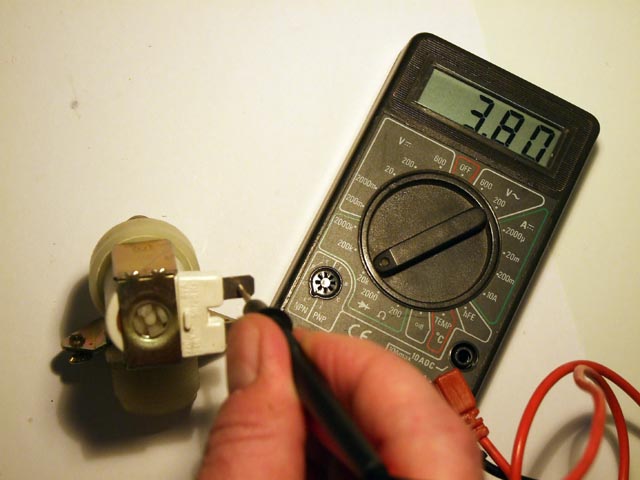
The test is straightforward and requires a multimeter set to the resistance measurement position at 20K (20 KiloOhms):
- Unplug the washing machine from the mains
- Disconnect the spade connectors (faston) from the solenoid
- Touch the multimeter probes to the two connectors on the inlet valve
- Read the value on the display: you should get a resistance of around 3,000 - 4,000 Ohms (3-4 KOhms), as shown in the photo
If the display shows "1" on the left-hand side — which is how digital multimeters indicate infinite resistance — it means the winding is broken and the solenoid has burnt out. In this case the only solution is the complete replacement of the inlet valve with an original or compatible spare part for your washing machine model.
Internal Mechanism Blocked: How to Test the Inlet Valve Directly
-
If the multimeter test came back fine — the solenoid is intact — but the inlet valve still isn't working, you may be dealing with an internal mechanical blockage: the diaphragm or armature are stuck and won't move even when the solenoid is powered.
In this case the most direct test is to power the inlet valve directly from the mains, following this procedure:
⚠️ Warning: this procedure involves direct connection to the 220-240V mains supply. Only carry it out if you have the necessary skills, with the utmost caution and always keeping a safe distance from any live contacts.
- Unplug the washing machine and disconnect the spade connectors (faston) from the inlet valve
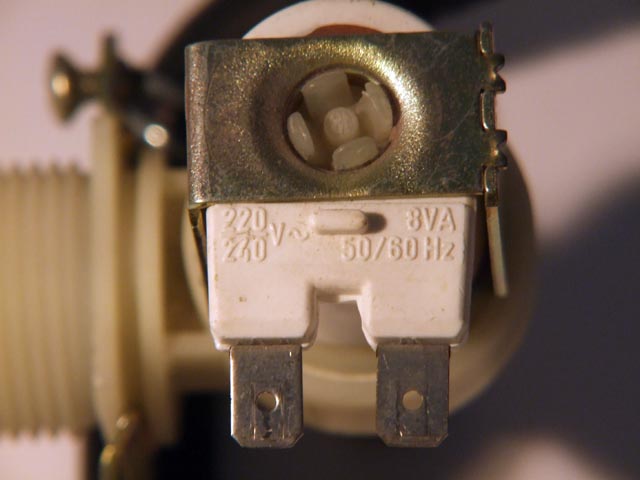
- Check the data printed on the solenoid body — as shown in the photo — to confirm that the valve is rated for 220-240V AC (in the photo: 220/240V, 8VA, 50/60Hz)
- Prepare a mains cable fitted with a plug at one end and insulated spade connectors at the other
- With both the inlet and outlet hoses connected, attach the insulated spade connectors to the valve's connectors
- Stand well clear and plug in: if the inlet valve is working correctly you'll immediately hear the sound of water flowing through towards the detergent drawer
If the valve still doesn't open even when powered directly, it is mechanically seized and needs to be replaced.
If on the other hand it works correctly, the problem lies upstream of the inlet valve and could be caused by:
- A fault with the door lock - see Washing Machine Door Lock and Interlock: How It Works, Diagnosis and Repair
- A break in the wiring supplying the inlet valve
- A fault with the washing machine's control unit
Frequently Asked Questions About the Washing Machine Inlet Valve (FAQ)
My washing machine isn't filling with water, is it definitely the inlet valve? Not necessarily. Before concluding that the inlet valve is to blame, it's worth checking a few simpler things first: is the water supply tap fully open? Is the supply hose kinked or crushed? Is the filter at the hose connection blocked? Only once you've ruled these out is it time to focus on the inlet valve itself, following the tests described in this article.
My washing machine is filling very slowly, where do I start? The first thing to do is clean the filter at the supply hose connection. It's the most common cause of this symptom and it's a simple, free fix. If the problem persists after cleaning, it could be a partially functioning solenoid or a damaged internal diaphragm.
How do I know if the solenoid has burnt out? Using a multimeter set to 20 KOhms, measure the resistance across the two solenoid connectors. The correct reading should be somewhere between 3,000 and 4,000 Ohms. If the display shows "1" (infinite resistance), the solenoid has burnt out and the inlet valve needs to be replaced.
Can I repair the inlet valve or do I have to replace it? It depends on the type of fault. If the filter is blocked, cleaning it is enough. If the solenoid has burnt out or the internal mechanism is seized and doesn't respond even when powered directly, replacement is the only option. Fortunately, replacement inlet valves are inexpensive and easy to find.
Where do I find the right replacement inlet valve for my washing machine? Spare parts are available from specialist appliance parts suppliers as well as online. To find the correct part you'll need the model number of your machine and, if possible, the part number printed on the body of the valve or the solenoid.
My washing machine throws an error straight after starting, could it be the inlet valve? Yes, it's a real possibility. If the inlet valve isn't opening, the machine won't be able to fill within the allotted time and will flag an error. Before working on the inlet valve though, it's also worth checking the pressure switch, which could be giving an incorrect water level reading even when the drum is filling correctly. To find out more, read: The Washing Machine Pressure Switch: How It Works
Conclusions and Acknowledgements
And here we are at the end of this guide: I hope that the explanation of how the inlet valve works has given you a clear picture of this small but essential component, and that the tips on the most common faults will come in handy the next time your washing machine decides it doesn't want to fill with water.
If after reading this guide you still have questions about how the washing machine works as a whole and how all the various components interact during a wash cycle, you'll find a complete explanation in the dedicated article: How Does a Washing Machine Work: Components, Diagram and Cycle Explained
If on the other hand the problem with your washing machine involves other components, you might also find these articles useful:
- Washing Machine Door Lock and Interlock: How It Works, Diagnosis and Repair
- The Washing Machine Pressure Switch: How It Works
If you've found this guide useful and would like to explore other home appliance repairs, you can carry on reading by visiting the other content in the Home Appliances section of the site, where you'll find many more practical guides and step-by-step explanations.
I care deeply about the quality and originality of the content I publish, and for this reason I'd prefer it not to be copied or republished elsewhere. If however you think this guide could be useful to others, I'd be really glad if you'd share the link to the page, it's the most straightforward way to spread the information and support the work that goes into every article.
Happy DIY Repairing, Everyone!
Luciano (Capitan Farloc)