
 English (United Kingdom)
  Italiano (Italia)
Indice
- How a Washing Machine Works: The Wash Cycle Explained Step by Step
- The Main Components of a Washing Machine: A Working Diagram
- How the Wash Cycle Works: The Step-by-Step Sequence
- The Programme Selector and Control Unit: The Brain of the Washing Machine
- From Mechanical to Electronic: The Evolution of the Programme Selector
- The Door Lock and Interlock: Safety First
- The Water Inlet Valve: The Washing Machine's Electric Tap
- The Detergent Drawer: How Water Reaches the Drum
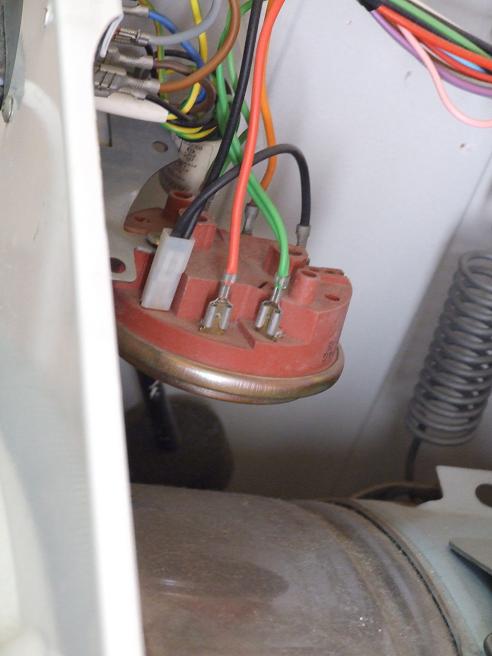
- The Pressure Switch: The Sensor That Measures the Water Level
- The Motor: Washing and Spinning
- The Heating Element and Temperature Sensor
- The Drain Pump: How Water Is Expelled from the Drum
- Frequently Asked Questions About Washing Machines (FAQ)
- Conclusions and Acknowledgements
How a Washing Machine Works: The Wash Cycle Explained Step by Step
Have you ever wondered what actually happens inside a washing machine while it's cleaning your clothes? Behind what seems like a simple gesture — loading the laundry, selecting a programme and pressing a button — there's actually a precise sequence of operations, coordinated by a series of electrical and mechanical components working in perfect sync.
In this article we'll explain how a washing machine works in a straightforward and accessible way: what the main components are, what they do and how they interact during a wash cycle. Understanding the mechanism will also help you recognise potential faults and, why not, have a go at fixing things yourself!
It's worth pointing out that not all washing machines are the same: some simpler models use an electromechanical programme selector (sometimes called a timer), while others are controlled by a full electronic circuit board with a microprocessor. Despite these differences, the basic working principle is always the same — and that's exactly what we're going to explore together.
The Main Components of a Washing Machine: A Working Diagram
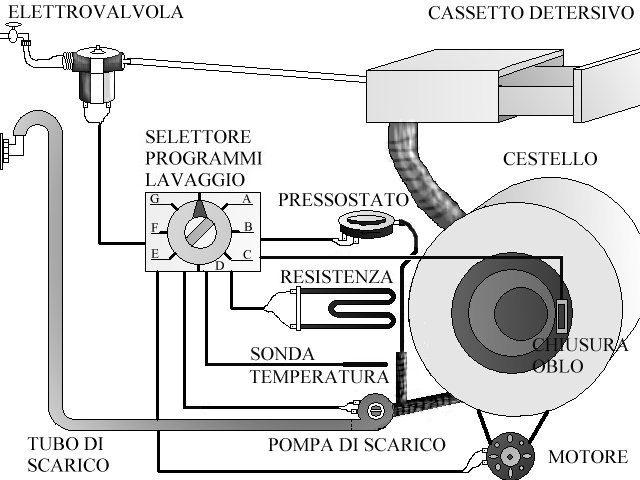
Before diving into the details of each individual component, it's useful to have an overview of how they are all connected inside the washing machine. The diagram below shows all the key players in the wash cycle and how they relate to each other: from the water inlet valve to the drain pump, taking in the programme selector, pressure switch, heating element, temperature sensor, motor and door lock.
Keep it as a reference as you read through the following sections — it will help you understand how each component fits into the overall working of the machine.
How the Wash Cycle Works: The Step-by-Step Sequence
The "brain" of the entire washing machine is the Programme Selector: in older machines it was an electromechanical system commonly known as a "Timer", while today it's an electronic circuit board called the Control Unit. It's this component that, by receiving information from the various sensors, coordinates all the other components in sequence. Here's how a typical wash cycle unfolds:
1) Door check and lock — First of all, the control unit verifies that the door is properly closed: if it isn't, the cycle won't start. Once closure is confirmed, an actuator locks the door for the entire duration of the wash.
2) Water intake — The Inlet Valve opens — an electrically controlled valve that lets water into the drum. The water passes through the Detergent Drawer, dissolving the detergent and carrying it into the drum.
3) Water level check — As the drum fills up, the Pressure Switch monitors the air pressure in a small tube connected to the bottom of the drum. When the water reaches the correct level, it signals the control unit to close the inlet valve.
4) Washing — The Motor kicks in and starts rotating the drum, combining the mechanical action of the tumbling laundry with the chemical action of the detergent. If the selected programme requires it, the Heating Element is switched on to heat the water to the set temperature, monitored by a dedicated sensor called the Temperature Sensor.
5) Drain and spin — The control unit activates the Drain Pump to expel the dirty water. The motor then increases its speed for the spin cycle, removing as much water as possible from the laundry.
Once the drain is complete, the cycle starts again with a fresh load of clean water for the rinse phase — without detergent this time — and so on until the programme is finished.
The Programme Selector and Control Unit: The Brain of the Washing Machine
This component is the true beating heart of the washing machine: it's the one that decides what to do and when to do it. In older machines, this took the form of an electromechanical system, the so-called Timer, in which a small motor slowly advanced a cylinder made up of a series of shaped wheels stacked on top of one another. The shape of each wheel determined whether an electrical contact was opened or closed, switching the various components (inlet valve, motor, heating element, pump…) on or off at exactly the right moment. The motor spun at a constant speed, governed by the frequency of the mains supply, ensuring that each phase of the wash cycle lasted precisely the right amount of time.

From Mechanical to Electronic: The Evolution of the Programme Selector
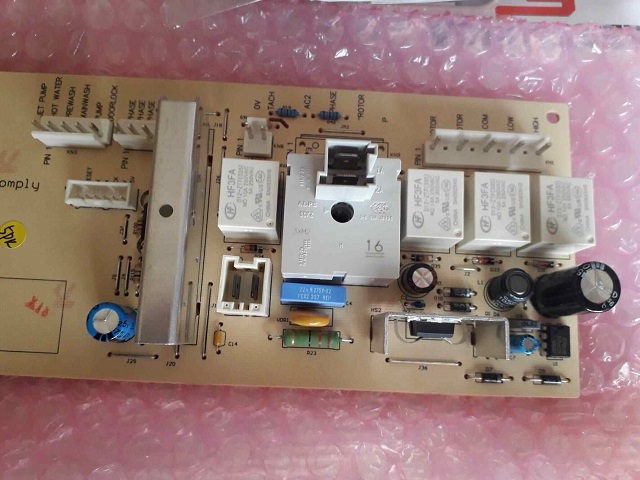
In modern washing machines, all of this has been replaced by an electronic circuit board with a microprocessor, just like in a computer. The programme is written into the board's internal memory, which receives real-time information from the sensors — door closure, water level, temperature — and autonomously decides when to move from one phase of the wash cycle to the next.
The Door Lock and Interlock: Safety First
The door lock is a component that performs two distinct but complementary functions.
The first is that of a closure sensor: it verifies that the door is properly shut before allowing the cycle to start. A simple safety measure that prevents the machine from running with the door open.
The second is that of a locking actuator: once the cycle has started, the control unit activates the door lock for the entire duration of the wash, preventing it from being opened accidentally.
There are two behaviours that might seem unusual but are in fact perfectly normal. The first is that the door lock remains active for around 30 to 60 seconds even after the machine has been switched off — just wait and it will release on its own. The second, typical of older machines, is that the actuator takes a few seconds to engage at the start of the cycle, during which the machine appears unresponsive: this too is completely normal.
If, on the other hand, the machine won't start despite the door being closed, and the problem is only resolved by shutting the door more firmly, it's likely that the closure sensor is beginning to fail — a sign that the component will need replacing before long.
For a more in-depth look at how the door lock works and how to check whether it's functioning correctly, read the dedicated article:
How the washing machine door lock system works

The Water Inlet Valve: The Washing Machine's Electric Tap
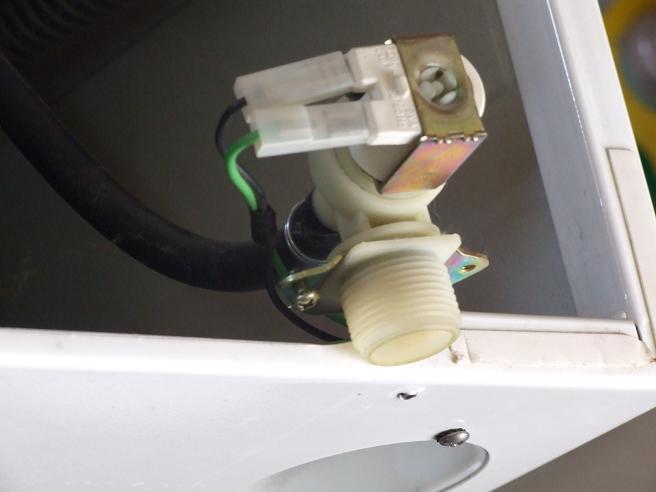
The word "valve" might bring to mind the old thermionic valves used in vintage radios, but in this context it simply means a flow regulator — in practice, a tap. The inlet valve is therefore an electrically controlled tap that the control unit opens and closes to manage the water intake into the drum.
It is located at the point where the water supply hose connects to the machine, and the threaded fitting where the hose screws in is generally already part of the valve itself. On its body you can easily identify the solenoid: an electrical coil to which the two command wire connectors are attached. When current flows through it, the solenoid generates a magnetic field that attracts a metal armature, mechanically opening the valve and allowing water to flow from the supply hose into the rubber tube that carries it through to the detergent drawer.
For a more in-depth look at how the inlet valve works and how to check whether it's functioning correctly, read the dedicated article:
How a washing machine's solenoid valve works
The Detergent Drawer: How Water Reaches the Drum
The water coming in through the inlet valve is directed straight into the detergent drawer — that pull-out compartment we all know, where we load the detergent, fabric softener and, if needed, bleach or pre-wash product.
The water always passes through this drawer, but only in the first phase of the cycle does it encounter the detergent to dissolve. During the subsequent rinse phases the compartment is already empty, and the water simply flows through it on its way to the drum via the outlet tube.
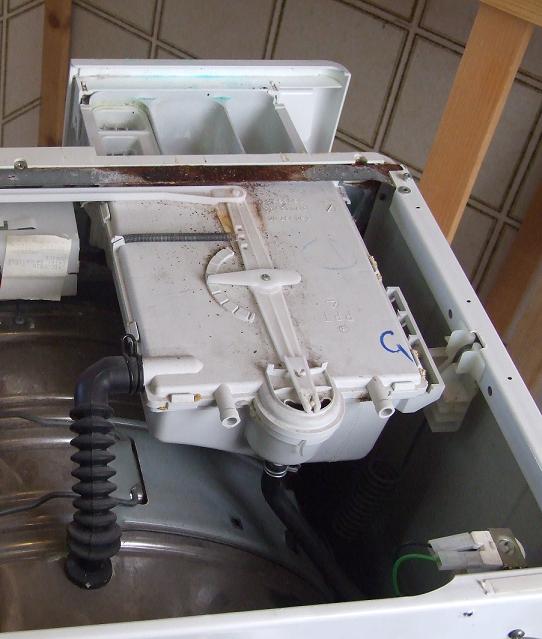
What's interesting is that the drawer is divided into several compartments, and depending on the phase of the cycle the water is directed into one rather than another. In older machines this routing was managed by a system of levers mechanically linked to the programme selector knob. In modern machines it is the control unit that handles everything via an electromechanical mechanism.
The photo shows a mechanical-type drawer: at the top you can make out the linkage driven by the selector knob, and the lever that shifts the water flow from one compartment to another. The small pointer at the centre of the lever is used for calibrating the mechanism — something carried out at the factory during assembly and that should never be adjusted.
The Pressure Switch: The Sensor That Measures the Water Level
The water coming in through the inlet valve, after passing through the detergent drawer, flows down into the drum through a tube positioned at the top, falling like a shower onto the drum and the laundry inside. But how does the washing machine know when the drum is sufficiently full to close the inlet valve and move on to the next phase?
The component responsible for this is the pressure switch — a pressure sensor connected via a thin rubber tube to the bottom of the drum. As the water level rises, the pressure of the air trapped in this tube increases. When the pressure reaches the value corresponding to the desired water level, the pressure switch trips and sends a signal to the control unit, which proceeds to close the inlet valve and continue with the cycle.
A simple yet effective mechanism that requires no direct contact with the water to do its job.
For a more in-depth look at how the pressure switch works and how to check whether it's functioning correctly, read the dedicated article:
The Washing Machine Pressure Switch: How It Works
The Motor: Washing and Spinning
When the drum starts turning, the washing machine gets down to its real work. The rotation is transmitted to the drum via a belt connecting the motor to a pulley mounted on the back of the outer drum — clearly visible in the photo. Over the years, three different types of motor have been used, each with its own advantages and drawbacks.
- The asynchronous motor is the oldest of the three and is found mainly in older machines. It works by exploiting a rotating magnetic field generated by phase-shifting the alternating current, achieved by means of a capacitor. The direction of rotation can be reversed simply by changing the capacitor connection. Its great strengths are robustness and near-zero maintenance requirements; the drawback is that the rotation speed is strictly tied to the frequency of the mains supply, which limits the machine to just two speeds: one for washing and one for spinning.
- The brushed motor dominated the market for many years and is still found in a large number of machines in use today. It has copper windings on the rotor which, fed via sliding graphite contacts known as brushes, interact with the stator magnets to generate movement. The main advantage is the ease with which the speed can be varied, allowing for a range of spin speed options. The downside is that the brushes wear down over time and need to be periodically replaced.
- The brushless inverter motor is the most modern technology and is now increasingly common in mid-range and high-end machines. In this type of motor there are no brushes or sliding contacts: rotation is generated by a magnetic field controlled electronically by an inverter, which precisely regulates speed and torque at every phase of the cycle. The advantages over older technologies are considerable: lower energy consumption, quieter operation, reduced mechanical wear and a much wider range of speeds. It's no coincidence that washing machines with brushless inverter motors are often rated among the most energy-efficient on the market.

The Heating Element and Temperature Sensor
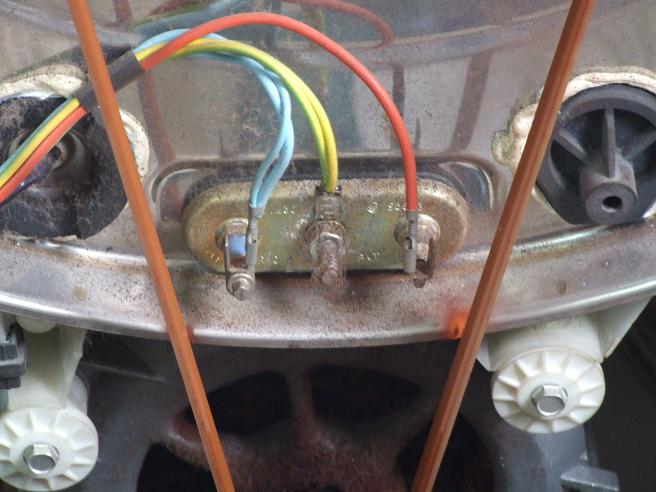
It's well known that detergent works better in warm water, dissolving more easily and removing dirt more effectively. For this reason, the washing machine is fitted with an electric heating element immersed in the outer drum, which heats the water during the wash phase.
The heating element doesn't stay on for the entire cycle: it's the temperature sensor that constantly monitors the water temperature and signals the control unit when the set temperature has been reached, at which point the heating element is switched off.
In older machines this control was handled by one or two simple thermostat switches, which limited the choice to just one or two wash temperatures. Modern machines, on the other hand, manage the temperature sensor directly through the control unit, which is able to read its values with precision and offer the user a much wider range of selectable temperatures — from 20°C for a cold wash all the way up to 90°C for the most robust fabrics.
The Drain Pump: How Water Is Expelled from the Drum
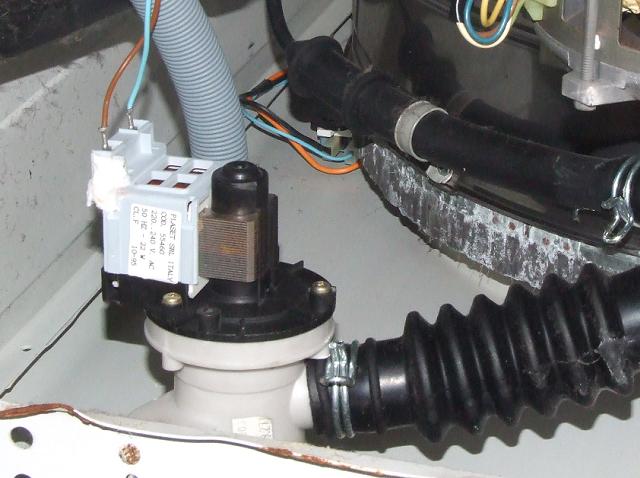
Every phase of the wash cycle ends with the drum being emptied. This is the job of the drain pump, a centrifugal type component: inside it, a small rotating impeller sets the water spinning in a vortex which, by centrifugal force, pushes it upwards through the drain hose and out through the outlet pipe.
The draining process is timed: the control unit keeps the pump running for a predetermined period, calculated to be sufficient to empty the drum completely. In most machines there is no dedicated water level sensor for the drain phase — it's simply a matter of timing. That said, some machines do include a minimum water level check, which allows the control unit to flag an anomaly if too much water is still present in the drum after the set time has elapsed.
One practical detail worth remembering: on the body of the pump there is a filter, accessible from outside the machine via a cap located at the front lower panel, often hidden behind a small plastic cover. This filter's job is to catch any foreign objects that have made their way into the drum — coins, buttons, fabric debris — and it should be cleaned periodically to prevent a blockage from slowing down or stopping the drain altogether.
Frequently Asked Questions About Washing Machines (FAQ)
- My washing machine won't start: what's the problem? The two most common causes are: the door isn't properly closed, or the door lock sensor isn't working correctly. If you try closing the door more firmly and the machine starts, it's likely that the door lock needs replacing. To find out how to check it, read: How the washing machine door lock system works
- My washing machine isn't taking in water: what should I check? The first component to check is the water inlet valve. It may be blocked by limescale, or the solenoid may not be working correctly. To find out how to check it, read: How a washing machine's solenoid valve works
- My washing machine is taking in too much or too little water: what's causing it? The culprit is almost certainly the pressure switch — the sensor that measures the water level in the drum. If it's faulty or the connecting tube is blocked, the signal it sends to the control unit will be incorrect. To find out how to check it, read: The Washing Machine Pressure Switch: How It Works
- The door stays locked after the wash cycle: is that normal? Yes, perfectly normal. The door lock remains active for 30 to 60 seconds after the machine is switched off as a safety measure. If however the door stays locked for an unusually long time or behaves abnormally, it could be a fault with the door lock. To find out how to check it, read: How the washing machine door lock system works
- My washing machine isn't heating the water: which component is faulty? There are two possible causes: the heating element may have burnt out, or the temperature sensor may not be working correctly.
- My washing machine won't drain or drains slowly: what should I do? First of all, check and clean the drain pump filter, accessible from the front lower panel of the machine. If the filter is clean and the problem persists, the pump itself may be faulty.
- The spin cycle isn't working or is too slow: where do I start? The problem could lie with the motor or, in older machines, with worn brushes. In some cases the control unit may also be involved.
Conclusions and Acknowledgements
And here we are at the end of this guide: I hope that the explanation of how a washing machine works has given you a clear and complete picture of what happens inside it with every wash cycle. Understanding the main components — from the control unit to the drain pump — is the first step towards tackling any maintenance or repair job with confidence.
If after reading this guide you've identified a possible problem with your washing machine, I've published a number of dedicated articles that walk you through the diagnosis and testing of each individual component in detail:
- For the door lock and interlock: How the washing machine door lock system works
- For the water inlet valve: How a washing machine's solenoid valve works
- For the pressure switch: The Washing Machine Pressure Switch: How It Works
If you've found this guide useful and would like to explore other home appliance repairs, you can carry on reading by visiting the other content in the Appliances section of the site, where you'll find many more practical guides and step-by-step explanations.
I care deeply about the quality and originality of the content I publish, and for this reason I'd prefer it not to be copied or republished elsewhere. If however you think this guide could be useful to others, I'd be really glad if you'd share the link to the page — it's the most straightforward way to spread the information and support the work that goes into every article.
For questions, clarifications or simply to let us know you enjoyed the article, feel free to post in the dedicated discussion thread on the forum:<Come Funziona una Lavatrice - FORUM> (Please note that the forum is in Italian only, but we will do our best to reply to messages written in English too)
Happy DIY Repairing, Everyone!
Luciano (Capitan Farloc)