
 English (United Kingdom)
  Italiano (Italia)
Indice
- Washing Machine Pressure Switch: Everything You Need to Know Before You Start
- What Is the Pressure Switch (and What It Isn't)
- How Does the Pressure Switch "Sense" the Water Level?
- The Air Trap: The Link Between the Drum and the Pressure Switch
- The Pressure Switch and Connecting Tube: Where It's Located and How It's Secured
- The Internal Mechanism of the Pressure Switch: How the Diaphragm Works
- Connections and Settings on the Pressure Switch: How to Read the Contacts
- The Wiring Diagram Stamped on the Pressure Switch
- Washing Machine Overfilling or Not Filling? Faults, Symptoms and Solutions
- Frequently Asked Questions About the Washing Machine Pressure Switch (FAQ)
- Conclusions and Acknowledgements
Washing Machine Pressure Switch: Everything You Need to Know Before You Start
Is your washing machine overfilling and flooding, or never filling up enough and throwing an error before it's even started washing? Or perhaps it keeps refilling after it seemed to have finished? In all these cases the culprit is almost certainly the same component: the pressure switch (also known as the water level sensor), the sensor that tells the washing machine how much water is in the drum.
It's a small, often overlooked component — but without it the washing machine would have no way of knowing when to stop filling or when it's time to move on to the next phase of the cycle. In this guide we'll look at what it is and how it works, how it connects to the drum, how to read its electrical contacts and — above all — how to diagnose the most common faults and check whether it really is the source of the problem: everything you need to fix it yourself without calling out a repair technician.
What Is the Pressure Switch (and What It Isn't)
The name can be misleading, so let's start with a couple of useful clarifications:
- It's not a pressure regulator — that's a completely different device that does something else entirely
- It's not a pressure gauge — that's another instrument used to measure pressure
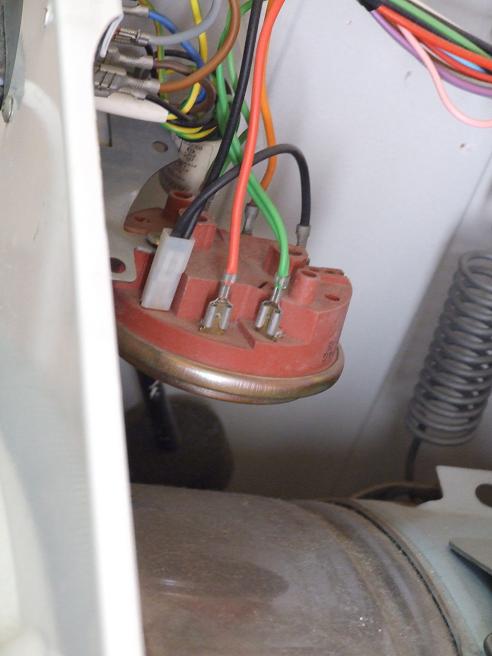
The pressure switch (or water level sensor) is instead a sensor that detects when a predefined pressure level has been exceeded, opening or closing an electrical contact in response. In even simpler terms: it's a switch that trips when the pressure inside it rises above (or falls below) a certain threshold.
In the washing machine this component is used to detect when the water in the drum has reached the correct level for the current phase of the cycle — washing or rinsing — and to signal the control unit to close the inlet valve and stop the fill.
How Does the Pressure Switch "Sense" the Water Level?
The question arises naturally: if the pressure switch is an air pressure sensor, how does it detect the water level in the drum? The trick is simple and elegant.
From the bottom of the drum runs a fairly wide rubber tube, known in the trade as an "air trap". When the drum is empty, this tube is full of air. As the drum fills with water, the air trap also begins to fill from the bottom, progressively compressing the air trapped in the upper part of the tube.
This compressed air is channelled through a narrower tube up to the pressure switch, which is factory-calibrated to trip at exactly the pressure corresponding to the optimal water level for the current phase of the cycle. When the threshold is reached, the pressure switch opens (or closes) its electrical contact, signalling the control unit to stop the fill.

The Air Trap: The Link Between the Drum and the Pressure Switch
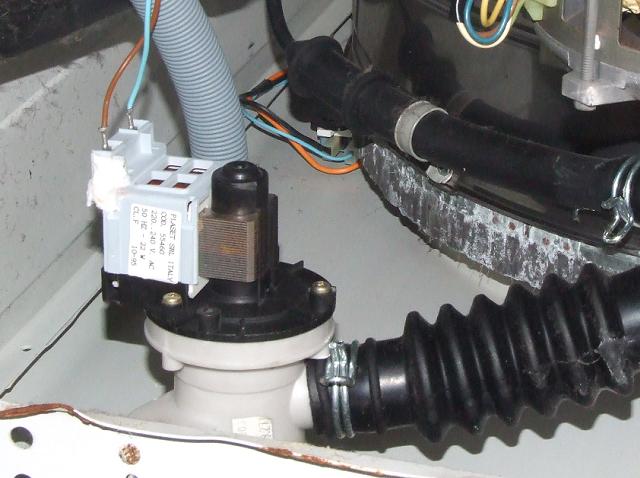
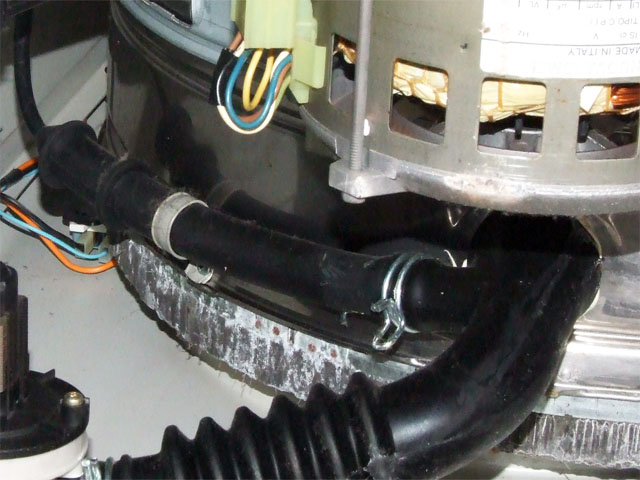
In the photo you can clearly see the air trap in the upper right: it's that section of wide, smooth tubing that runs up from the bottom of the drum, gradually narrowing until it connects to the thinner tube that reaches the pressure switch. It's an apparently simple component, but absolutely essential for the correct operation of the entire water level detection system.
The Pressure Switch and Connecting Tube: Where It's Located and How It's Secured
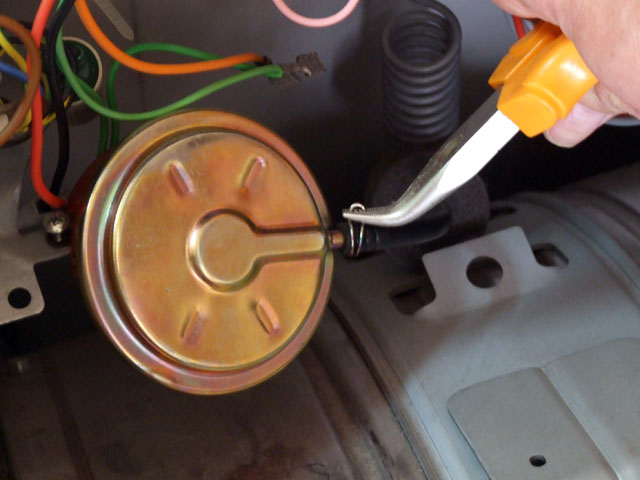
In this photo you can see the pressure switch in its position at the top of the washing machine, with the narrow tube coming from the air trap already connected to its inlet. The hose clip holding it firmly in place is also clearly visible.
All the joints in this circuit — both on the air trap and on the connecting tube — are secured with hose clips to prevent any air leaks. Even a small leak, seemingly harmless, is enough to prevent the pressure in the circuit from ever reaching the level needed to trip the pressure switch, resulting in the drum overfilling or the machine stopping with an error. It's therefore important that all the hose clips are tight and correctly positioned.
The Internal Mechanism of the Pressure Switch: How the Diaphragm Works
Looking inside the pressure switch reveals a simple yet effective electromechanical mechanism. Here's how it works:
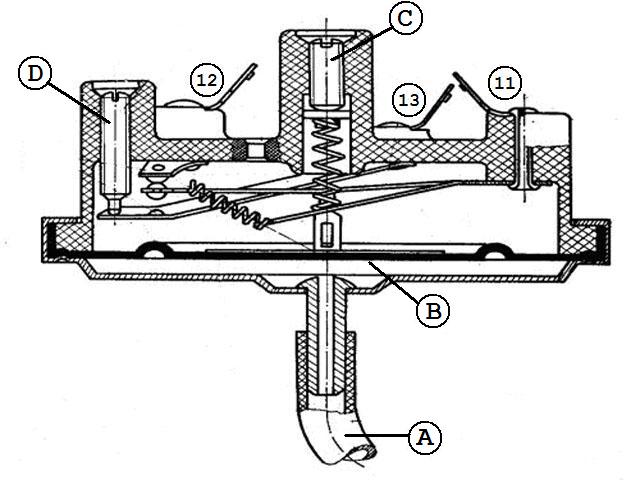
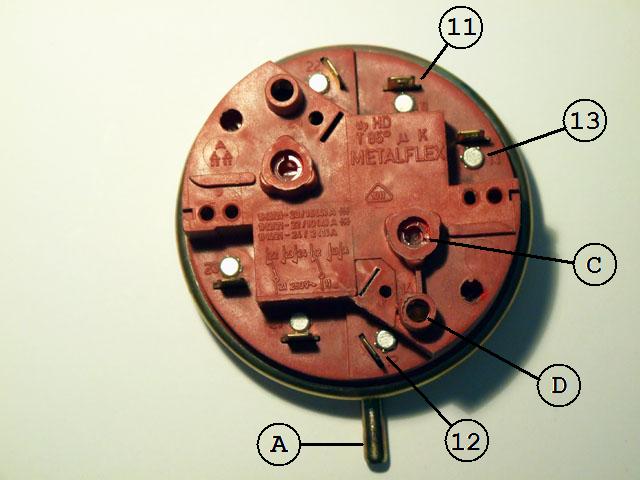
The air coming from the air trap enters through tube (A) into the expansion chamber, where it compresses the rubber diaphragm (B). As the water level rises and the pressure increases, the diaphragm progressively deforms upwards.
The diaphragm is held back by a spring whose tension is set by screw (C): it's this setting that defines the pressure threshold — and therefore the water level — at which the pressure switch must trip. When the pressure exceeds the threshold, the diaphragm overcomes the resistance of the spring and activates the switch, whose contacts are identified by the numbers (11), (12) and (13).
Screw (D) is used to adjust the hysteresis of the switch — that is, the pressure difference from the trip threshold that the switch needs in order to return to its resting position once the water level has dropped. In many modern pressure switches this setting is fixed and the corresponding screw is not present.
💡 Note: both adjustment screws (C) and (D) are factory-calibrated and should not be adjusted under normal circumstances.
Connections and Settings on the Pressure Switch: How to Read the Contacts
The pressure switch is factory-calibrated and under normal circumstances requires no adjustment. It is however useful to know how to read the contacts and adjustment screws, especially when carrying out a diagnosis.
How many switches can a pressure switch have? A pressure switch can contain one, two or even three independent switches, each with its own contacts and settings. The one in the photo has two. Multi-switch pressure switches are used to manage different water levels depending on the phase of the cycle:
- The first switch manages the level for washing — less water, to save on detergent and energy for heating
- The second switch manages the level for rinsing — more water, to remove detergent residue more effectively
- The third switch (if present) manages the level for half load — even less water for light washes with fewer items
How to identify the adjustment screws: Screws (C) and (D) must always be aligned with each other. Screw (C), the water level adjustment, is always in the more central position. Screw (D), the hysteresis adjustment, is closer to the edge and is generally found near connector (12). In many pressure switches the hysteresis setting is fixed and screw (D) is not present.
How to identify the electrical contacts: The contacts are identified by numbers stamped on the body of the pressure switch:
- (11) — central contact of the switch (common)
- (12) — NC (Normally Closed) contact: closed at rest, opens when the water level is reached
- (13) — NA (Normally Open) contact: open at rest, closes when the water level is reached
- (14) — if present, a second NA contact identical to the previous one
The Wiring Diagram Stamped on the Pressure Switch
On the back of the pressure switch you can often find the electrical wiring diagram of the internal switches stamped directly onto the body — exactly as shown in the photo. It's a very handy reference when carrying out a diagnosis, as it allows you to identify the contacts with certainty without having to track down the component's data sheet.
As you can see, the diagram reflects exactly what was described in the previous section. If the pressure switch contains more than one switch and uses the same identification standard shown in the photo, the contacts of the additional switches follow this progressive numbering:
- Second switch: (21) — (22) — (23) — (24)
- Third switch (if present): (31) — (32) — (33) — (34).

Washing Machine Overfilling or Not Filling? Faults, Symptoms and Solutions
A faulty pressure switch almost always shows up as a problem during the fill phase: the drum fills too much, doesn't fill at all, or the machine stops with an error message before it's even started washing. Let's look at the most common faults and how to deal with them.
Blocked Air Trap: The Machine Overfills or Won't Fill at All
The first thing to check is that the entire air circuit — from the drum all the way to the pressure switch — is clear and free of blockages. It's a more common problem than you might think, especially in households that use excessive amounts of detergent or frequently wash heavily soiled or greasy items: over time a greasy residue builds up inside the air trap and can end up blocking it completely, preventing air from reaching the pressure switch.
The consequences can be two, apparently opposite:
- Overfilling — if air can't get into the pressure switch, it never trips and the inlet valve stays open, continuing to fill the drum beyond the correct level
- Failure to fill — if air can't escape from the pressure switch, it remains stuck in the tripped position and signals to the control unit that the drum is full even when it's completely empty
The fix is straightforward: loosen the hose clip securing the air trap, pull it off its fitting, inspect it and clean it thoroughly.
Air Leak in the Circuit: The Machine Keeps Refilling
Another common cause of malfunction is an air leak in the circuit. If the pressure can't build up correctly the pressure switch never trips, with the result that the drum overfills — or, after the fill seemed to have finished, starts again and keeps going until the water level is too high.
The leak can occur at three different points:
- Cracked pressure switch diaphragm — the internal diaphragm has deteriorated and no longer holds pressure
- Cracked connector tube or air trap — small cracks, often invisible to the naked eye, that form especially where the hose clips have left their mark on the rubber
- Loose hose clip — the joint is no longer airtight and air is escaping
How to test the pressure switch diaphragm:
- Connect a transparent tube to the pressure switch inlet
- Blow gently until you hear the switch trip
- Quickly plug the tube with your finger and wait at least one minute
- If the switch releases with the tube still plugged, the diaphragm is cracked and the pressure switch needs to be replaced
- If the switch only trips again after you remove your finger from the tube, the diaphragm is intact and the leak is to be found elsewhere
How to check the tubes and hose clips: Visually inspect the full length of all the tubes looking for cracks, particularly in the areas where the hose clips have been sitting. Make sure all the clips are tight and correctly positioned.

Faulty Electrical Contacts: How to Test the Pressure Switch Contacts
-
If the air circuit is intact and leak-free but the pressure switch still isn't working, the problem may lie in the electrical contacts of the internal switches, which over time can oxidise or deteriorate and lose contact.
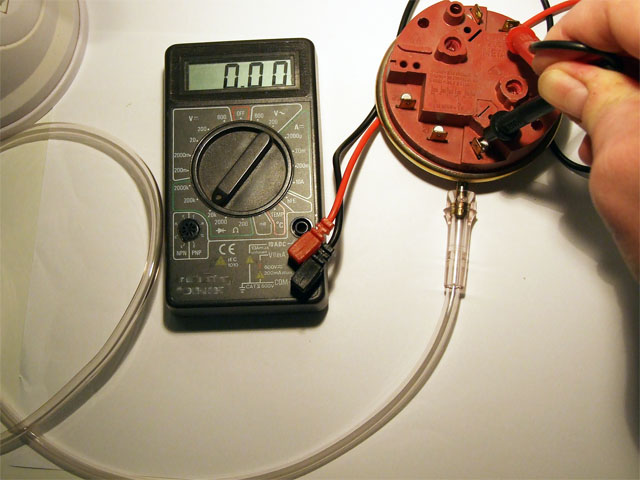
For this test you'll need two tools:
- The transparent tube used in the previous test
- A multimeter set to measure electrical resistance (digital or analogue, it makes no difference)
The test is carried out by following the wiring diagram stamped on the pressure switch and checking that the contacts open and close correctly as you blow into and release the tube. For example:
Contacts (11) and (12) — NC (Normally Closed):
- At rest (without blowing): the resistance should be close to zero Ohms — the contact is closed
- Blowing until the switch trips: the resistance should become infinite — the contact has opened
Contacts (11) and (13) — NO (Normally Open):
- At rest (without blowing): the resistance should be infinite — the contact is open
- Blowing until the switch trips: the resistance should become close to zero Ohms — the contact has closed
If any of the contacts don't behave as described, the switch is faulty and the pressure switch needs to be replaced.
Frequently Asked Questions About the Washing Machine Pressure Switch (FAQ)
My washing machine is overfilling — is it definitely the pressure switch? It's one of the most likely causes, but not the only one. Before working on the pressure switch it's worth checking that the air trap isn't blocked and that all the connecting tubes are intact and securely fastened. If the air circuit is in order and the problem persists, then the pressure switch is almost certainly to blame.
My washing machine stops during the fill cycle and throws an error — could it be the pressure switch? Yes, it's a real possibility. If the pressure switch signals to the control unit that the drum is full when it's actually still empty — for example because the air trap is blocked or because there's an air leak in the circuit — the machine won't be able to fill with the water it needs and will stop with an error message. Before working on the pressure switch though, also check the inlet valve, which could be the real cause of the fill failure. To find out more, read: Washing Machine Inlet Valve: How It Works, How to Test It and How to Replace It
My washing machine starts refilling after it seemed to have finished — what does that mean? This symptom is almost always caused by an air leak somewhere in the pressure switch circuit. If the pressure doesn't hold steady, the pressure switch releases and the control unit interprets this as a drop in the water level, instructing the inlet valve to reopen. Test the pressure switch diaphragm using the tube test and check the integrity of all the connections.
How do I know if the pressure switch diaphragm is cracked? Connect a tube to the pressure switch inlet, blow gently until you hear the switch trip, then plug the tube with your finger and wait at least one minute. If the switch releases with the tube still plugged, the diaphragm is cracked and the pressure switch needs to be replaced. If it only trips again after you remove your finger, the diaphragm is intact.
Can I adjust the pressure switch myself? Technically yes, but it's not recommended. The pressure switch is precisely calibrated at the factory to ensure the correct water level at every phase of the cycle. An incorrect adjustment can lead to underfilling or overfilling, with a resulting drop in wash quality or even damage to the machine. If the pressure switch isn't working correctly, replacement is always the better option.
Where do I find the right replacement pressure switch for my washing machine? Spare parts are available from specialist appliance parts suppliers as well as online. To find the correct part you'll need the model number of your machine and, if possible, the part number stamped on the body of the pressure switch itself. Bear in mind that pressure switches with a different number of internal switches are not interchangeable.
Conclusions and Acknowledgements
And here we are at the end of this guide: I hope that the explanation of how the pressure switch works has given you a clear picture of this small but essential component, and that the tips on the most common faults will come in handy the next time your washing machine overfills, won't fill up or stops mid-cycle.
If after reading this guide you still have questions about how the washing machine works as a whole and how all the various components interact during a wash cycle, you'll find a complete explanation in the dedicated article: How Does a Washing Machine Work: Components, Diagram and Cycle Explained
If on the other hand the problem with your washing machine involves other components, you might also find these articles useful:
- Washing Machine Door Lock and Interlock: How It Works, Diagnosis and Repair
- Washing Machine Inlet Valve: How It Works, How to Test It and How to Replace It
If you've found this guide useful and would like to explore other home appliance repairs, you can carry on reading by visiting the other content in the Home Appliances section of the site, where you'll find many more practical guides and step-by-step explanations.
I care deeply about the quality and originality of the content I publish, and for this reason I'd prefer it not to be copied or republished elsewhere. If however you think this guide could be useful to others, I'd be really glad if you'd share the link to the page, it's the most straightforward way to spread the information and support the work that goes into every article.
Happy DIY Repairing, Everyone!
Luciano (Capitan Farloc)