
 English (United Kingdom)
  Italiano (Italia)
Indice
- Why electric water heater maintenance matters
- Tools you’ll need
- Difficulty, Time and Cost
- When to service your electric water heater
- How an electric water heater (boiler) works
- The check valve (and safety valve)
- How to drain the water heater
- Water draining from the heater
- Removing the bottom cover
- When the water heater stops heating
- Internal components of an electric water heater
- Cleaning the inside of the water heater
- Replacement parts and installation
- Conclusions and thanks
Why electric water heater maintenance matters
Regular maintenance of an electric water heater is essential if you want reliable hot water, lower energy bills and a longer lifespan for the appliance. Over time, limescale and mineral deposits naturally build up inside the tank, settling both on the heating element and along the inner walls. This gradual accumulation reduces efficiency, slows down heating times, causes unusual noises and leads to noticeably higher electricity consumption.
As the layer of limescale thickens, the heating element is forced to work at temperatures far higher than those it was designed for, which can eventually cause permanent damage. In situations like this, attempting to clean the element is often ineffective. Replacing it is usually the most practical and economical solution, restoring proper performance and preventing further strain on the system.
This guide walks through how an electric water heater works, why limescale forms, the warning signs of a failing heating element and how to carry out safe, step‑by‑step maintenance to keep your boiler running smoothly
.
Tools you’ll need
A small set of basic hand tools is enough to carry out most maintenance tasks on an electric water heater. Each tool plays a specific role, from loosening pipe fittings to checking electrical continuity, so having them ready makes the whole job smoother and safer.
- Open‑ended and socket spanners with ratchet — useful for removing nuts and bolts on the heater’s mounting plate and other mechanical parts.
- Adjustable pipe wrench or water‑pump pliers — ideal for gripping and loosening plumbing fittings without slipping.
- Screwdrivers (Phillips and flat‑head) — needed for removing the cover, accessing the thermostat and disconnecting electrical terminals.
- Pliers and side cutters — helpful for handling cables, tightening connectors and cutting worn or damaged wires if necessary.
- Multimeter — not strictly essential, but very useful for checking voltage, continuity and the condition of the thermostat and heating element before replacing anything
Difficulty, Time and Cost
This kind of job sits at a medium difficulty level. Anyone with a bit of confidence in basic plumbing and DIY can handle it without needing advanced technical skills. The only real requirement is taking care during reassembly, as even a small mistake in tightening fittings or positioning gaskets can lead to leaks.
- Difficulty: Medium
- Estimated time: 2–3 hours
- Overall cost: €15–25
These figures make it a very accessible maintenance task, especially considering how much performance and efficiency you can recover by replacing a worn heating element and clearing out limescale
When to service your electric water heater
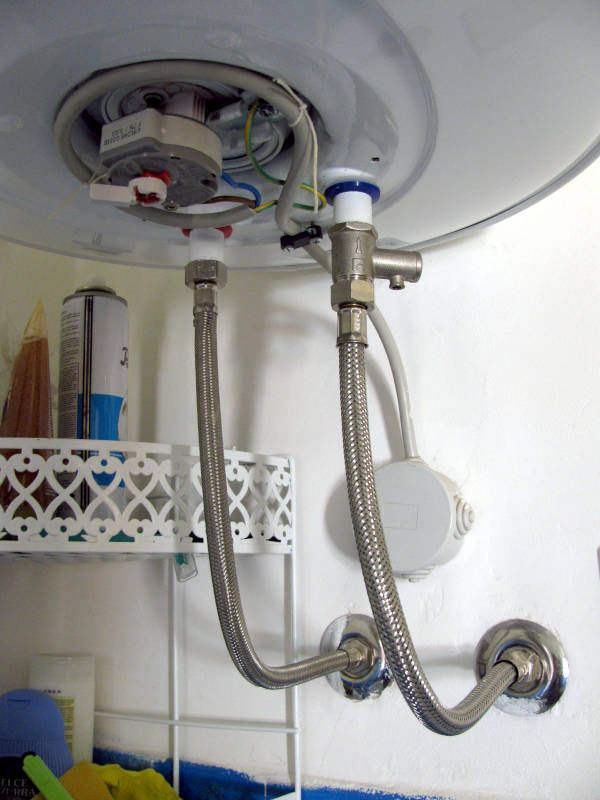
An electric water heater (often simply called a boiler) is particularly prone to limescale build‑up, especially in areas where the water is “hard” and rich in calcium. As these deposits accumulate inside the tank, several tell‑tale symptoms begin to appear, signalling that maintenance is due.
- A loud, unpleasant noise during the heating phase — the crackling or popping sound is caused by limescale heating up and moving around on the bottom of the tank.
- Longer heating times — the layer of limescale acts as insulation, preventing the heating element from transferring heat efficiently to the water.
- Less hot water available — deposits reduce the effective capacity of the tank and slow down heat distribution.
In more severe cases, the heater may eventually stop working altogether, usually because the heating element has been forced to operate at excessively high temperatures for too long.
How an electric water heater (boiler) works
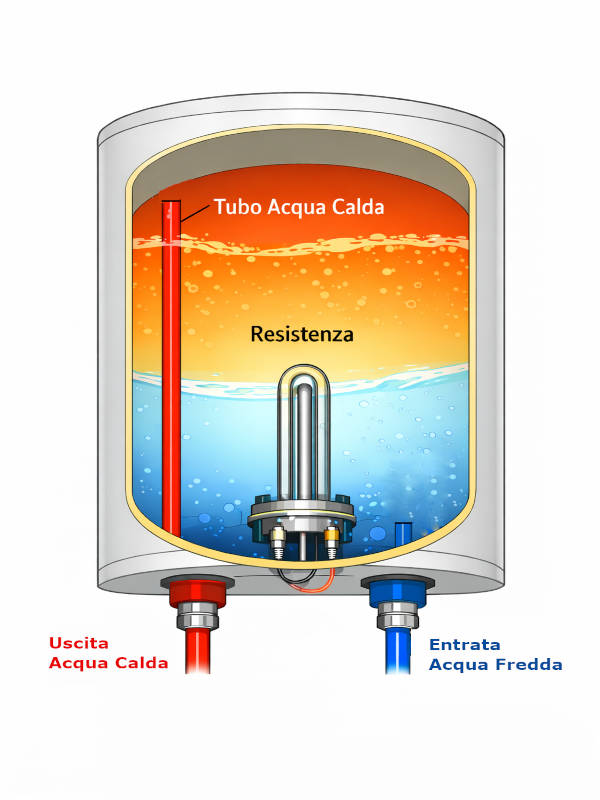
An electric water heater is built around a fairly straightforward system. Inside the unit sits an insulated tank designed to keep the stored water hot for as long as possible by reducing heat loss. At the heart of the appliance is the heating element, the component responsible for generating heat and bringing the water up to the set temperature.
A thermostat regulates the entire process. Once the water reaches the desired temperature, the thermostat cuts the power to the heating element, preventing overheating and unnecessary energy consumption. When the temperature drops, it switches the element back on, keeping the water consistently warm.
The cold‑water inlet pipe is positioned at the bottom of the tank, while the hot‑water outlet is located at the top. This layout follows the natural behaviour of water: hot water rises, cold water sinks. By drawing hot water from the upper part of the tank, the system ensures you always get the hottest water available, even while the heater is actively refilling and reheating.
The check valve (and safety valve)
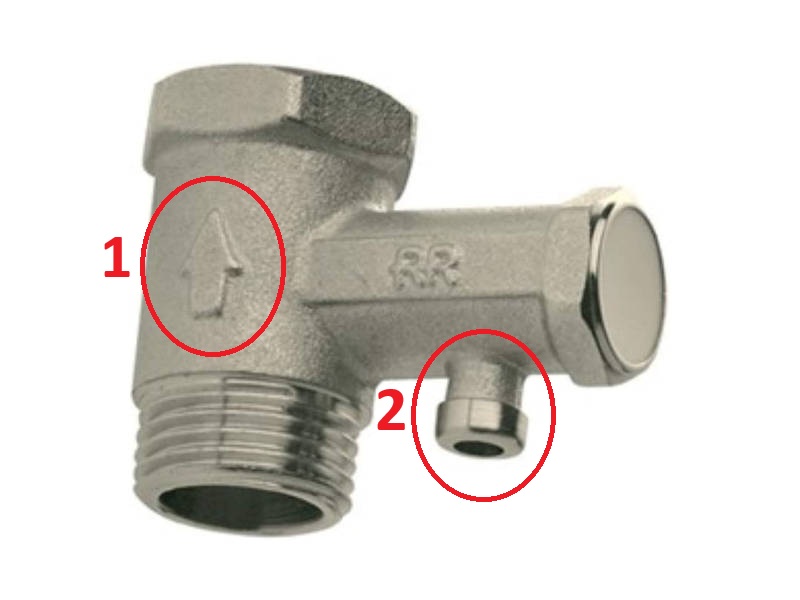
On the right‑hand side of the heater, fitted to the cold‑water inlet pipe, there’s a component that might look like a simple connector with a small side outlet. In reality, it performs two essential functions that keep the system safe and working properly.
The first is its role as a check valve, which allows water to flow in only one direction. This prevents hot water, once heated, from flowing back into the cold‑water supply line. The correct direction of flow is usually marked by a small arrow stamped on the body of the valve (1), making installation and inspection straightforward.
The second function is that of a safety valve. If the pressure inside the tank rises above the safe limit, the valve automatically opens and releases a small amount of water through a dedicated outlet (2). This immediate pressure relief protects the tank from excessive stress and avoids potentially dangerous situations.
How to drain the water heater
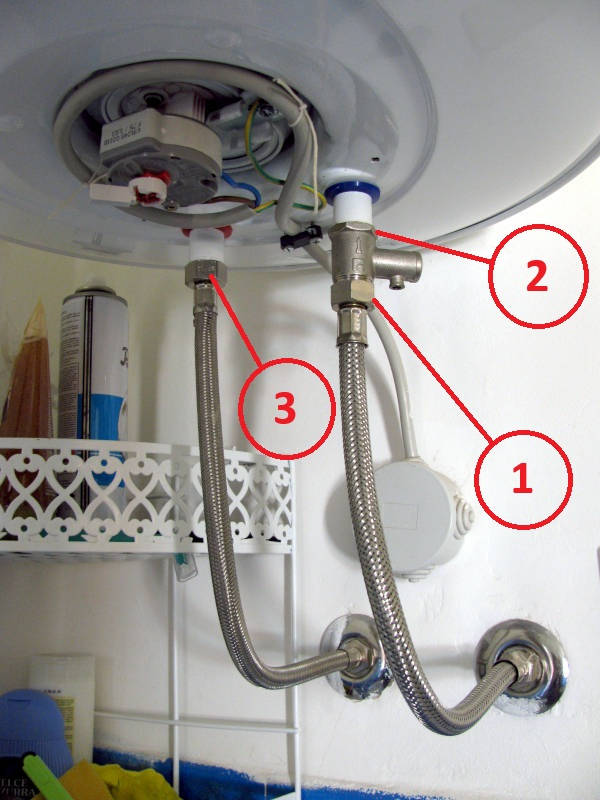
Before you can access the internal components and carry out any maintenance, the tank must be completely drained. This involves disconnecting both the inlet and outlet pipes using an open‑ended spanner or water‑pump pliers, but the steps need to be followed in the correct order to avoid leaks, splashes or electrical hazards.
- Switch off the main power supply
Because the heater is connected to the electrical system, the very first step is to make sure there is no electricity reaching the appliance. Turning off the main switch is always the safest option, even if your heater has its own dedicated switch. - Close the main water supply
Once the water is shut off, open one hot‑water tap and one cold‑water tap in the house. This helps release pressure from the system. When the water stops flowing, close both taps again. - Loosen the cold‑water inlet nut (1)
When you loosen this fitting, no water will come out yet. The check valve prevents any backflow from the tank. - Remove the check/safety valve (2)
Once the valve is removed, a small amount of water will begin to flow out, but only slowly because air cannot yet enter the tank. At this point, it’s a good idea to attach a long hose to the heater’s inlet connection so you can direct the water towards a drain, sink or bathtub.
Important: if a hot‑water tap has been left open by mistake, water may gush out much more quickly. Make sure all taps are closed before removing the valve. - Loosen the hot‑water outlet nut (3)
This final step allows air to enter the top of the tank, enabling the water to drain freely from the bottom through the hose connected to the cold‑water inlet.
Water draining from the heater
Once you’ve completed the steps described above, the tank will take a few minutes to empty fully. The flow starts slowly, then becomes steadier as air enters the system and the water finds its way out through the hose connected to the cold‑water inlet.
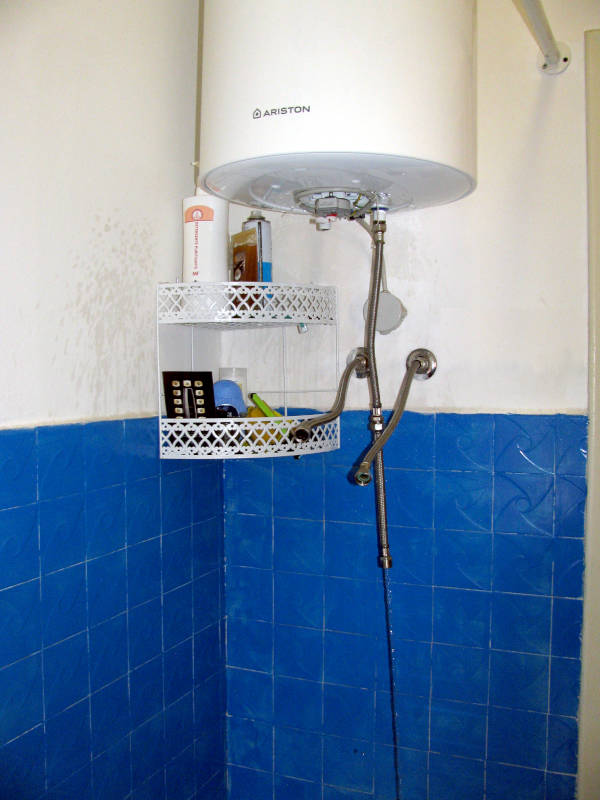
In the example shown in the photo, the heater was installed directly above a bathtub, so two flexible hoses were simply joined together and the water drained straight into the tub below. This is a practical solution whenever a suitable drain point is close by, as it avoids splashes and keeps the work area clean.
Removing the bottom cover
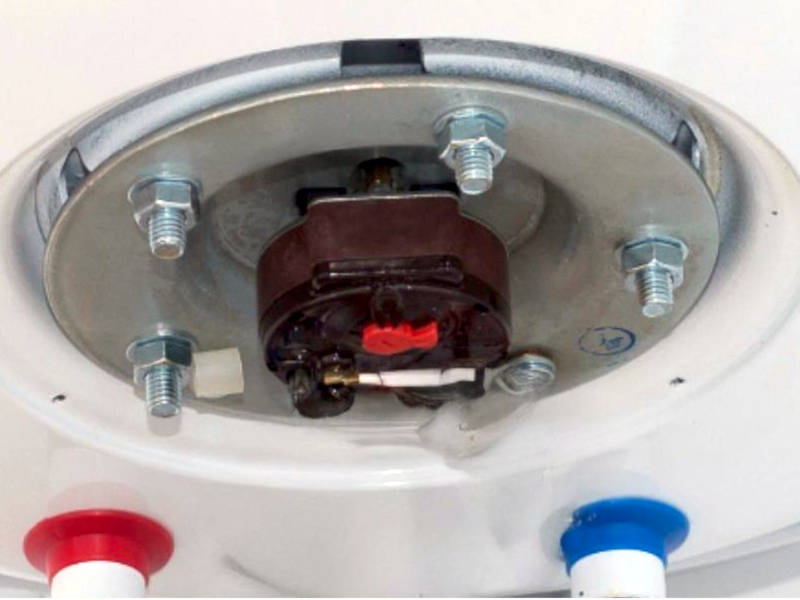
Once the plastic cover on the underside of the water heater has been unscrewed and taken off — it’s usually held in place by one or two screws — you finally gain access to the technical section of the appliance. Here you can clearly see the bottom plate of the tank, a metal component secured with several nuts and carrying both the heating element and the thermostat.
This plate is the main access point to the inside of the heater. By removing it, you can take out the heating element, check how much limescale has built up and carry out proper maintenance.
To remove it, loosen and take off the nuts that hold it in place. Once they’re off, the plate can be gently pulled out, giving you direct access to the tank and all the internal components.
When the water heater stops heating
Before removing the bottom plate and opening the tank, it’s worth checking whether the problem is actually caused by limescale or if it comes from one of the electrical components. In many cases, a water heater stops producing hot water simply because the thermostat or the heating element has failed. Doing these quick checks first saves time and helps you understand exactly what needs to be repaired.
Checking the thermostat:
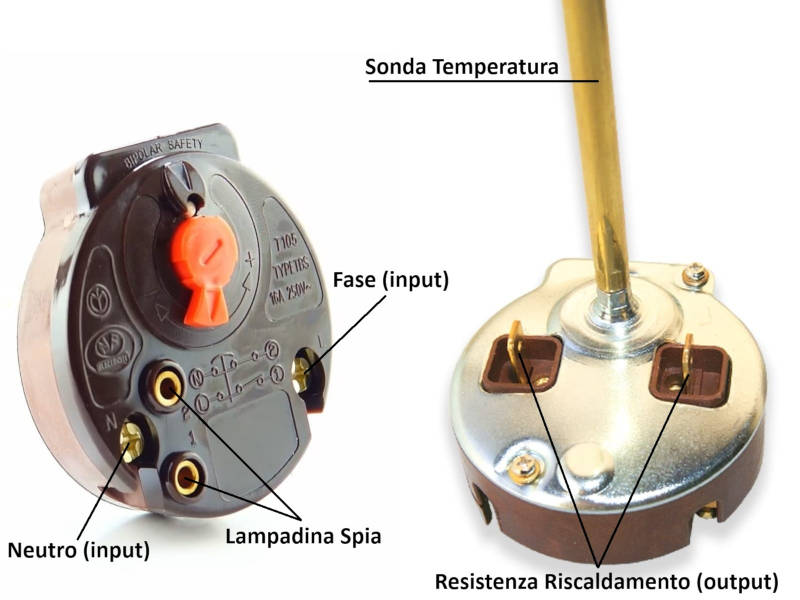
The thermostat sits in the centre of the bottom plate and can be removed easily by pulling it downwards. Once it’s out, the electrical contacts are clearly visible.
To test it, you just need a multimeter set to continuity mode:
- The neutral input should show continuity with one of the two output contacts leading to the heating element.
- The live input should show continuity with the other output contact.
If either of these paths shows no continuity (even after turning the thermostat knob to the maximum temperature), the thermostat isn’t closing the circuit properly and needs replacing.
A faulty thermostat is one of the most common reasons a heater stops warming water, and it’s also one of the easiest and cheapest components to replace.
Checking the heating element:
Once the thermostat is removed, the two terminals of the heating element are exposed. At this point, you can measure its electrical resistance using the multimeter set to the Ohms scale.
A working heating element should typically show a value between 40 and 50 Ω, depending on the heater’s power rating.
- If the multimeter shows infinite resistance, the element is broken.
- If the value is much higher than normal, the element is still compromised.
- If the value is correct but the heater still doesn’t warm up, the issue may lie elsewhere (wiring, connectors, power supply, safety thermostat).
If the heating element is faulty, replacement is the only solution. It cannot be repaired, and attempting to do so would not be safe.
Internal components of an electric water heater
Once the bottom plate has been removed, you finally have full access to the main internal components of the heater. Through this opening you can clearly see:
- the heating element, which brings the water up to the set temperature
- the magnesium anode, which protects the tank from corrosion
- the thermostat probe housing, where the thermostat senses the water temperature
These are the parts that most often require maintenance or replacement.
Condition of the heating element
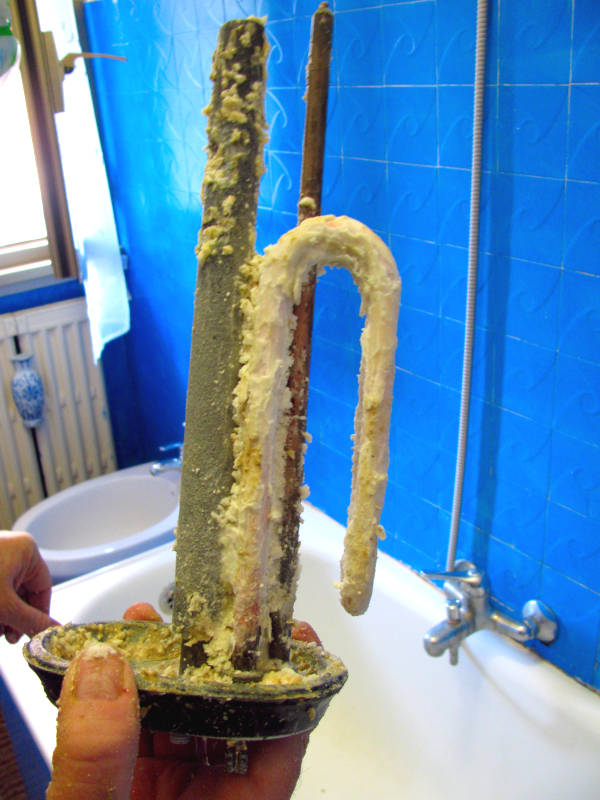
If the heating element is covered in a thick layer of limescale — which is very common after years of use — it’s usually not worth trying to clean it. Even when it still works, the limescale acts as thermal insulation, preventing proper heat transfer to the water. This forces the element to operate at higher temperatures than intended, increasing the risk of:
- weakening of the metal
- deformation
- premature failure
For this reason, when the element is heavily encrusted, replacing it is the most sensible option. The cost is low, and it prevents you from having to open the heater again shortly afterwards.
Condition of the magnesium anode
The magnesium anode is a rod roughly 15–25 cm long and a couple of centimetres in diameter. Its role is crucial: it sacrifices itself to protect the tank from corrosion caused by water oxidation.
Over time, the anode becomes thinner and may wear down almost completely. If it looks very reduced, irregular or heavily corroded, it’s time to replace it. A healthy anode significantly extends the life of the tank and reduces the risk of leaks or structural damage.
Cleaning the inside of the water heater
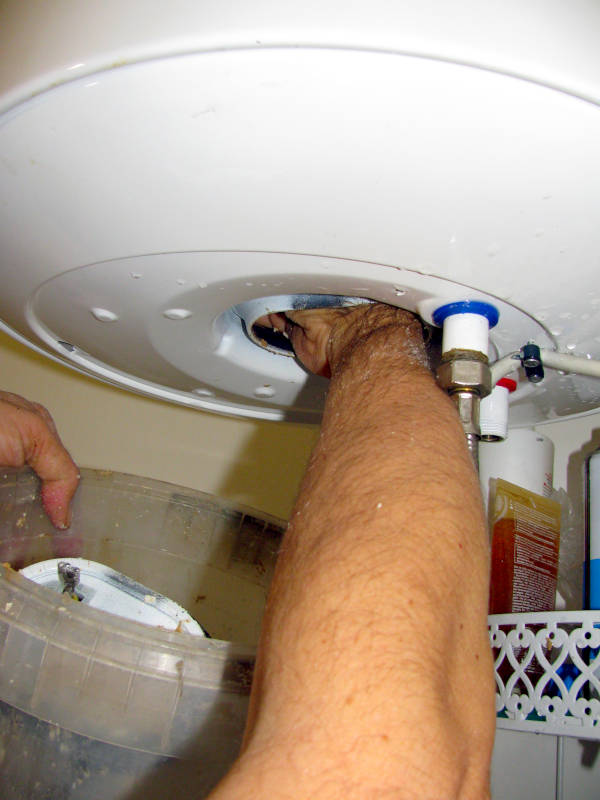
When the bottom plate is removed, you can clearly see not only the heating element and the magnesium anode, but also the bottom of the tank, where large amounts of limescale tend to accumulate over time. Besides the hard crust that forms around the heating element, limescale often breaks into flakes and granules that settle at the bottom.
These deposits can be removed easily by reaching through the opening and collecting them by hand, letting them fall into a bucket placed underneath the heater. It’s a simple task, but an essential one if you want the appliance to run efficiently and last longer.
Why removing limescale from the tank matters
The limescale inside the tank isn’t just an aesthetic issue. If left to build up, it can cause several problems:
- Reduced useful capacity — a thick layer of deposits takes up space inside the tank, reducing the actual amount of hot water available.
- Noise during operation — limescale flakes can move and vibrate as the water heats up, creating banging or metallic noises.
- Slower heating — limescale obstructs water circulation around the heating element and worsens heat transfer, making the heater less efficient.
Keeping the inside of the tank clean ensures better performance, lower energy consumption and a longer lifespan for the entire system.
Replacement parts and installation
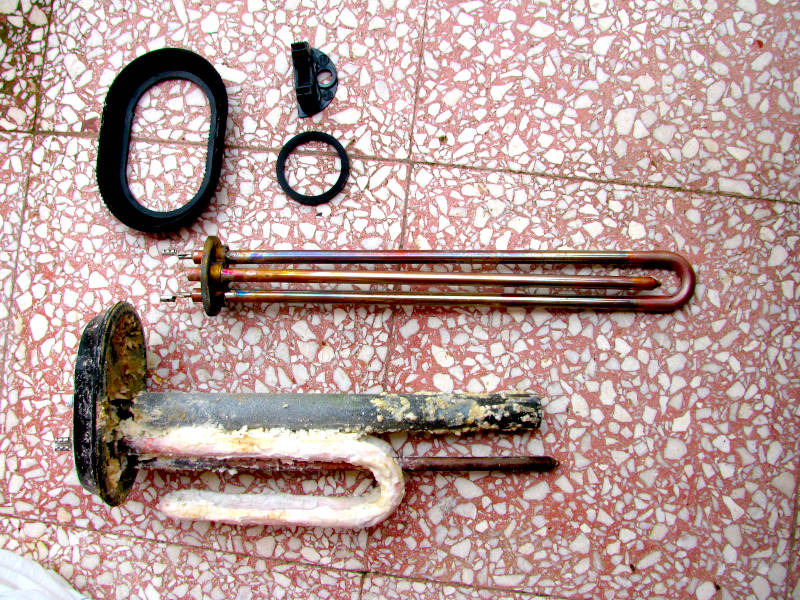
Once you know which components need replacing, you can move on to buying the spare parts and fitting them. Choosing compatible, good‑quality parts is essential, as proper maintenance ensures years of trouble‑free operation.
One item that is always worth buying together with the main replacement parts is the bottom‑plate gasket. Even if it doesn’t show visible cracks, the gasket tends to harden, deform and lose elasticity over time. Re‑using an old gasket significantly increases the risk of:
- small leaks that worsen gradually
- immediate dripping after reassembly
- having to reopen the heater later just to replace it
Given that the gasket is inexpensive, replacing it every time is the safest and most cost‑effective choice. It ensures a perfect seal and prevents future problems.
Conclusions and thanks
Thank you for following this guide on maintaining an electric water heater. Understanding the internal components and the correct procedures makes every intervention safer, helps you solve the most common issues and extends the lifespan of the appliance.
If you found this article helpful and would like to explore more home‑maintenance topics, you can browse the other guides available in the plumbing section of the website where you’ll find practical, step‑by‑step explanations on many similar tasks.
I care deeply about the quality and originality of the content I publish, so I prefer that it isn’t copied or republished elsewhere. If you think this guide could be useful to others, I’d be genuinely pleased if you shared the link to this page. It’s the most respectful way to spread the information and support the work that goes into each article.
Happy DIY repairs to everyone
Luciano (Capitan Farloc)